
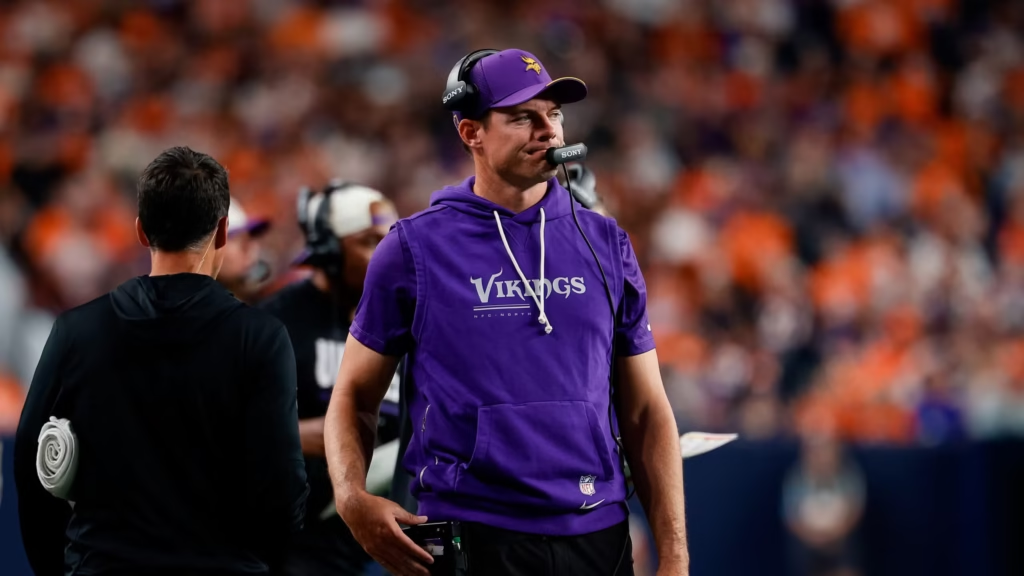
The Vikings are 3–0 and on a win streak stretching back to the start of December, but there are still questions about the state of the offense. Club member Patrick Garforth examines the details behind those questions and how hot Kevin O’Connell’s seat is getting.
On the face of it, questioning a head coach whose team has started the season 3–0 sounds ridiculous. But if I’m the Wilfs, I’m looking beyond the Minnesota Vikings’ record and asking a more uncomfortable question: is Kevin O’Connell still the right man to lead this organisation long-term?
I’m not suggesting for one minute that O’Connell should be fired tomorrow. We’re 3–0 and there’s a long season ahead. But being undefeated shouldn’t stop us questioning what we’re actually seeing, particularly on offense.
Because these problems haven’t suddenly appeared over the first three games of 2026. For me, they go back much further.
The offensive problems aren’t new
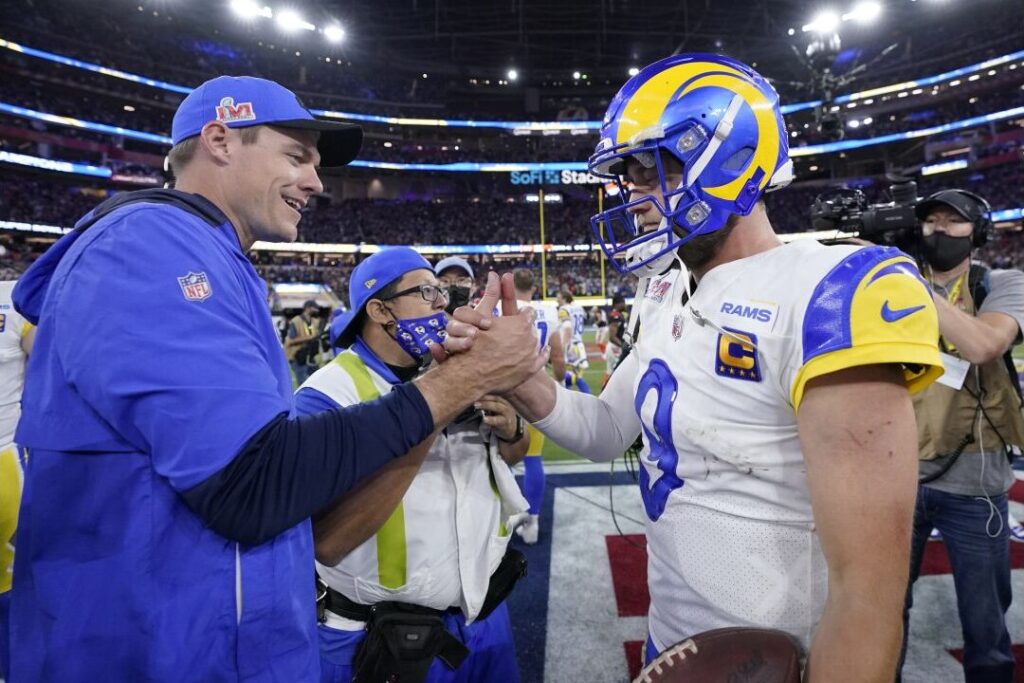
Since the win over Green Bay at the end of 2024 season (Sam Darnold’s last home game), the Vikings’ offense has too often looked predictable and disjointed, particularly when the original gameplan isn’t working. That concerns me because offense is supposed to be Kevin O’Connell’s speciality.
O’Connell arrived in Minnesota with a reputation as an innovative offensive coach, fresh from Sean McVay’s Super Bowl-winning staff. As a former quarterback, he was also seen as someone who could develop the Vikings next rookie QB.
So, when the offense becomes one of the team’s biggest concerns, it’s fair to start asking questions, and the biggest one surrounds what has happened at quarterback.
Ten starts and we’re done with McCarthy?
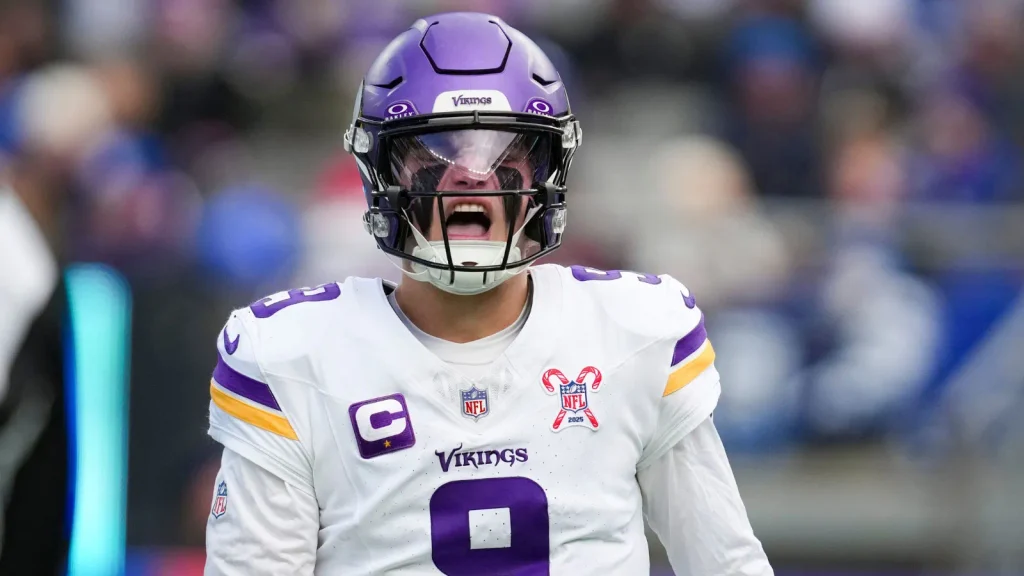
Minnesota selected J. J. McCarthy with the 10th overall pick in the 2024 Draft. This wasn’t a developmental gamble in the later rounds. The Vikings invested one of the most valuable assets a franchise has in a player they believed could be their quarterback for the next decade.
O’Connell was heavily invested in McCarthy and publicly backed him following the meniscus injury that wiped out his rookie season. Now, after just 10 regular-season starts for Minnesota, he’s gone.
Whatever you think of McCarthy – and I’m certainly not suggesting he’d shown enough to prove he was a franchise quarterback – that’s an incredible amount of draft capital to give up on so quickly.
O’Connell wasn’t the GM when McCarthy was drafted, so obviously the entire decision can’t be placed at his door. But he was the head coach, the offensive playcaller and the man entrusted with developing him. He was also heavily involved in the process that resulted in Minnesota drafting McCarthy in the first place. You can’t completely separate him from it.
McCarthy and Dallas Turner
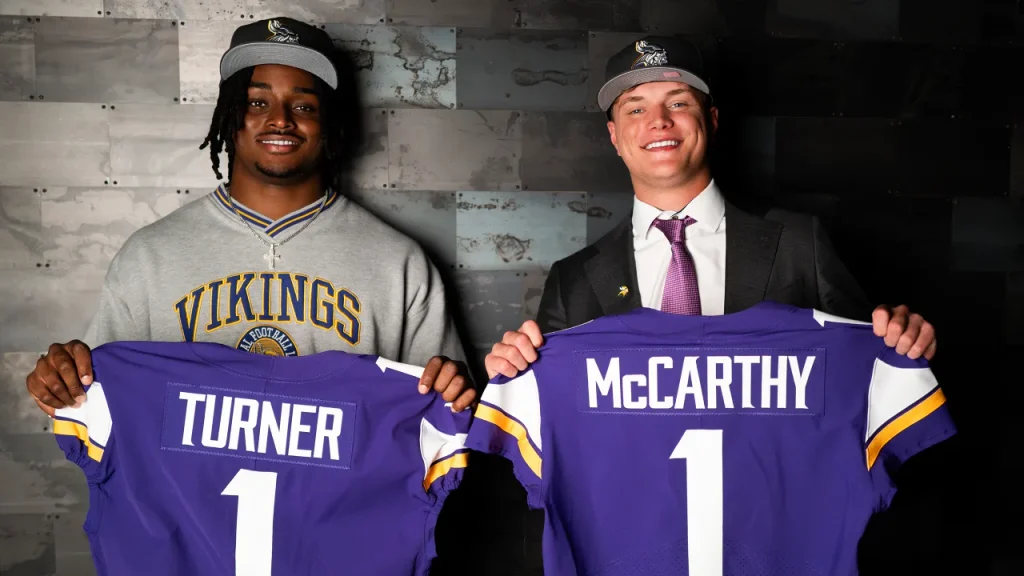
There’s also an interesting comparison with Minnesota’s other first-round pick from that draft. Dallas Turner was taken seven picks after McCarthy and didn’t exactly set the world alight when he first arrived either.
I’m not trying to compare playing edge in the NFL with playing quarterback; they’re completely different positions. The comparison I’m making is about patience. Turner struggled. Questions were asked about the pick. But he was given time, coaching and reps, and allowed to develop. With McCarthy, it feels like that patience disappeared very quickly.
What makes it even more frustrating is that when Minnesota finally started making adjustments to help McCarthy towards the end of 2025, he actually improved. The games against the Cowboys and Giants before his injury showed that both visually and statistically.
That doesn’t mean McCarthy was suddenly destined to become a great quarterback. At this point, we don’t even know if the guy can stay healthy for six consecutive games, never mind a full NFL season.
But that’s almost the point. Did we actually establish that McCarthy couldn’t become an NFL quarterback, or did Minnesota simply decide it wasn’t prepared to wait any longer to find out? For the 10th overall pick after only 10 starts, I find that difficult to understand.
The handling of the quarterbacks doesn’t add up
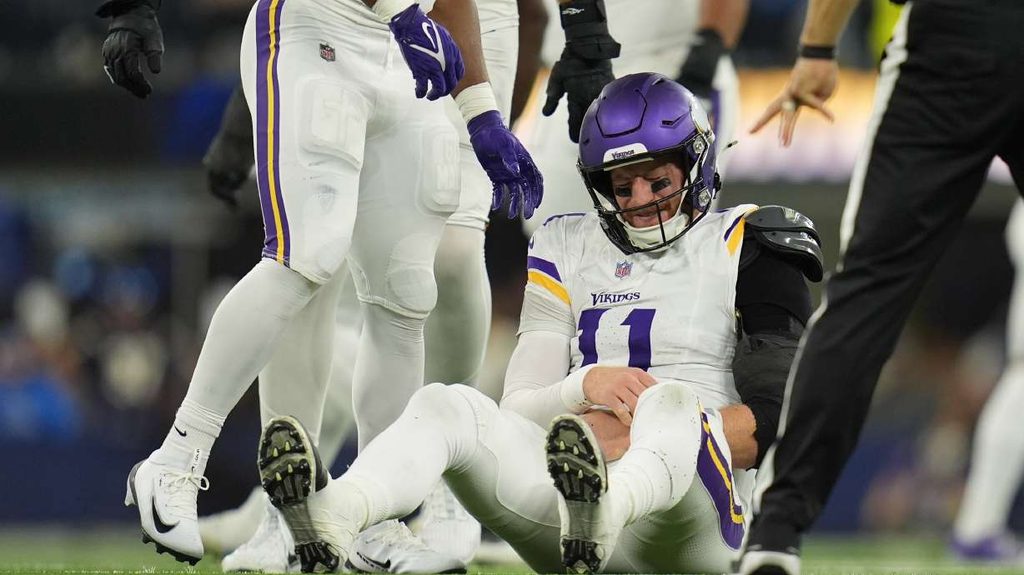
This is probably the part of O’Connell’s handling of McCarthy that bothers me most. We repeatedly heard that McCarthy wouldn’t play unless he was fully healthy. Fair enough. He’s a young quarterback who had already lost an entire season to a serious knee injury.
But then we watched Carson Wentz on Thursday Night Football. Wentz was clearly injured and was eventually shown to have a season-ending shoulder injury. Watching him in obvious agony and then crying on the sideline was genuinely difficult to watch.
Meanwhile, an apparently healthier McCarthy was standing on the sideline. He certainly looked more capable of moving around than Wentz at that point, even jumping out of the way of a falling Chargers player despite supposedly being affected by his high ankle sprain.
Then, a few months later, McCarthy himself is sent out for the season finale with a confirmed broken hand. This wasn’t a playoff game. Minnesota wasn’t fighting to keep its season alive. In fact, losing would have left the Vikings with the worst divisional ranking and potentially a more favourable schedule in 2026.
Yet McCarthy – effectively still a rookie in terms of actual NFL experience after missing all of 2024 – was out there trying to play quarterback with a hand injury that affected his ability to grip the football. I just don’t see how those decisions fit together.
There may be medical information we don’t know about, and obviously we’re looking at it from outside the building. But from the outside, the handling of the quarterback position has looked inconsistent.
More influence means more accountability
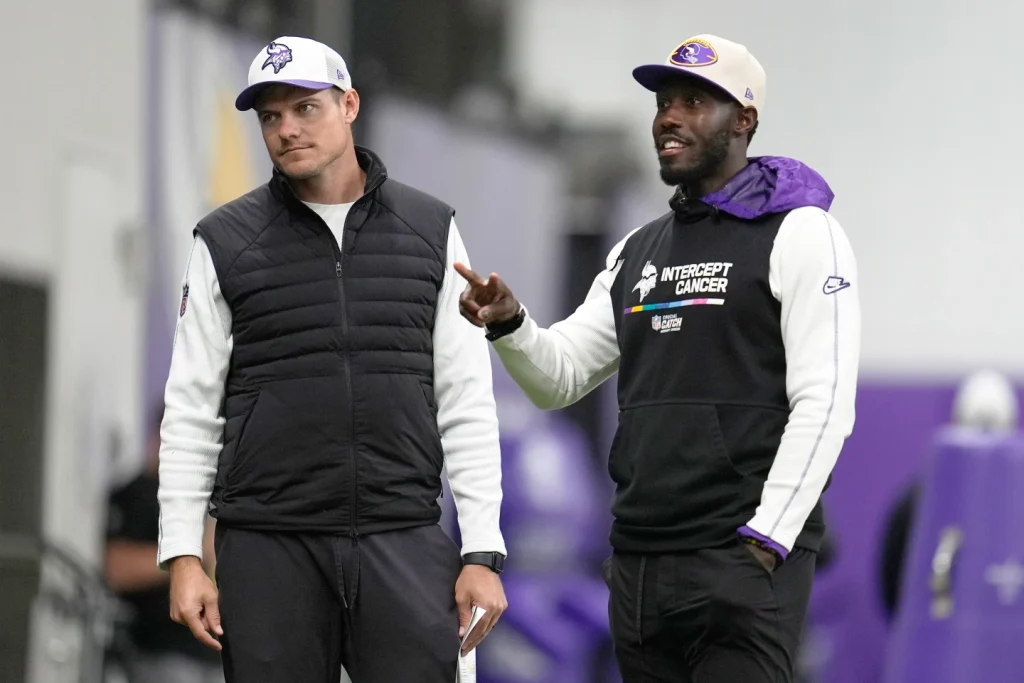
This offseason makes all of this more important. The Vikings parted ways with their GM shortly before the draft. The timing raised questions: Kwesi Adofo-Mensah had represented the team at the Senior Bowl just days before his dismissal, and reports suggested O’Connell had led internal personnel discussions in his absence.
O’Connell and his coaching staff were then given greater influence over personnel decisions. If you have more influence, you also have to accept more accountability when decisions don’t work.
Which brings us to Kyler Murray…
Does Murray actually fit what KOC wants to do?
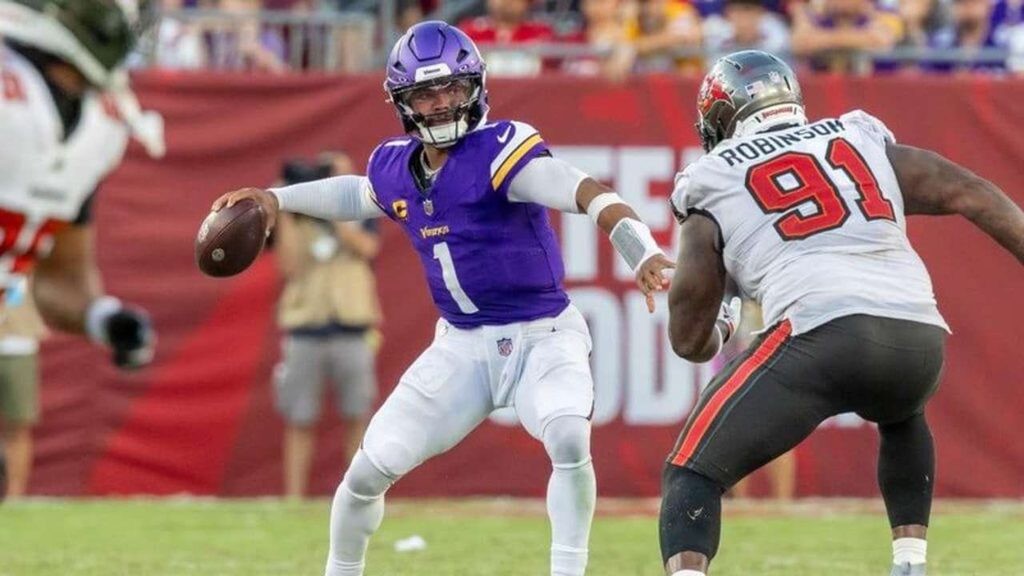
This is another decision I struggle with.
Murray has spent virtually his entire NFL career playing predominantly from pistol and shotgun. O’Connell’s offense has traditionally used plenty of under-center football and play action, and likes attacking further downfield. Murray doesn’t have one of the strongest arms in the NFL either.
So what exactly was the plan when Minnesota decided he was the guy? I’m not saying signing Murray was necessarily a mistake, but once you sign him, surely you build around what he’s good at? Develop the quick game. Use his mobility. Give him slants and crossing routes. Use mesh concepts. Create easy completions inside 10 yards and get the football into the hands of your playmakers quickly.
Instead, the offense currently seems caught between what Murray naturally does well and what O’Connell wants his offense to be. It feels very similar to one of my frustrations with McCarthy. Are we finding quarterbacks to suit O’Connell’s offense, or changing O’Connell’s offense to suit the quarterback we’ve got? At the moment, I’m not sure we’re doing either particularly well.
And what was that QB competition about?
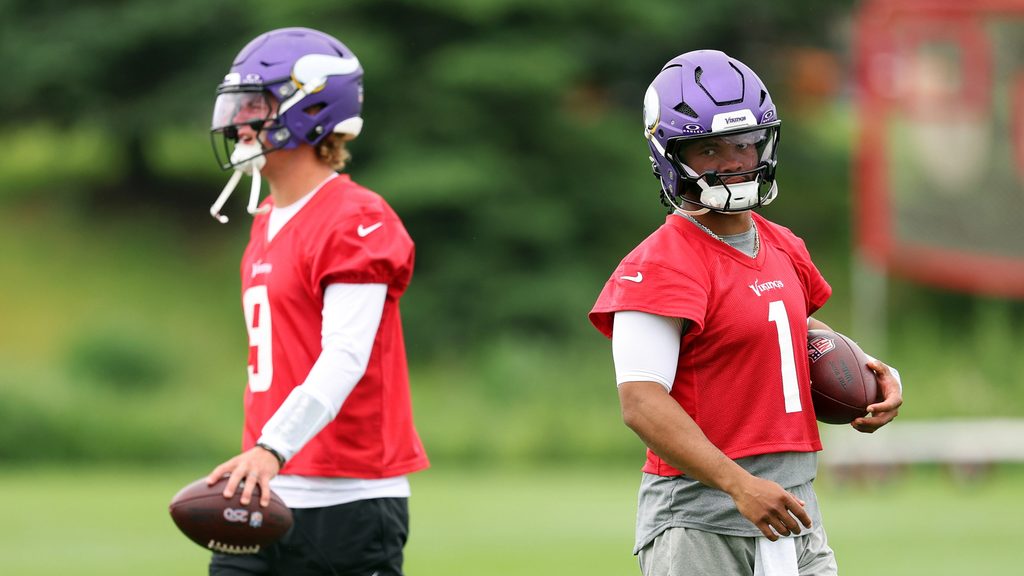
Then there’s the quarterback competition over the summer. You’ve just signed Murray and brought him into an offense that everyone tells us is notoriously complicated. Surely you want him taking as many first-team reps as possible? He needs to learn the terminology, understand the system, and develop timing with Justin Jefferson and the rest of the offense.
Instead, those reps are divided because we’re apparently having a genuine quarterback competition. Then the guy Murray was competing against ends up third string before the season even starts. That’s the bit I don’t understand.
If it genuinely was a close competition, how does one of those quarterbacks fall to third string almost immediately afterwards? And if Murray was always the likely starter, why waste valuable first-team reps he clearly needed? What did we actually gain from it?
3–0 doesn’t mean everything’s fine
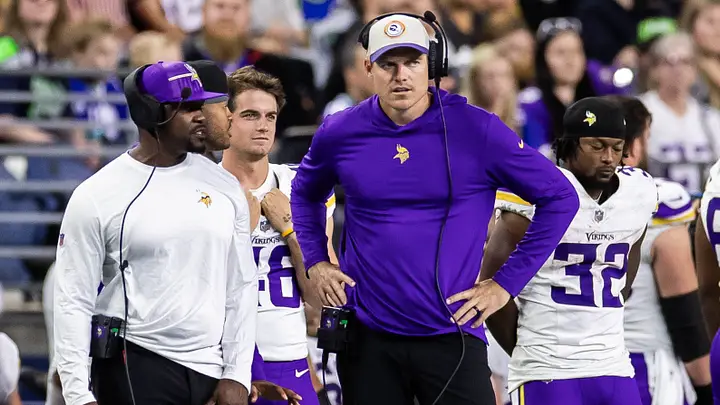
This is where the record comes back into it. Minnesota is 3–0. That’s great. Winning games in the NFL is difficult and nobody should apologise for it, but let’s be realistic about how those games are being won. Brian Flores’ defense is providing the foundation for this team right now.
I’m not trying to turn this into O’Connell versus Flores. Having a brilliant defensive coordinator is a positive for O’Connell, not a criticism of him. My concern is what’s happening on his side of the football. We’re constantly told about O’Connell’s offensive intelligence and creativity, but right now I’m struggling to see much of it.
The screen game remains poor. We hardly seem to use slants. Mesh concepts and shorter crossing routes that could give Murray easier completions seem underused. Too often the offense lacks rhythm and when the initial approach isn’t working, I don’t see enough adjustment.
Bad games happen. Bad drives happen. But this has been going on for long enough now that I don’t think you can just dismiss it as a slow start. At some point, KOC has to find a Plan B when Plan A isn’t working.
For me, this season is massive for O’Connell
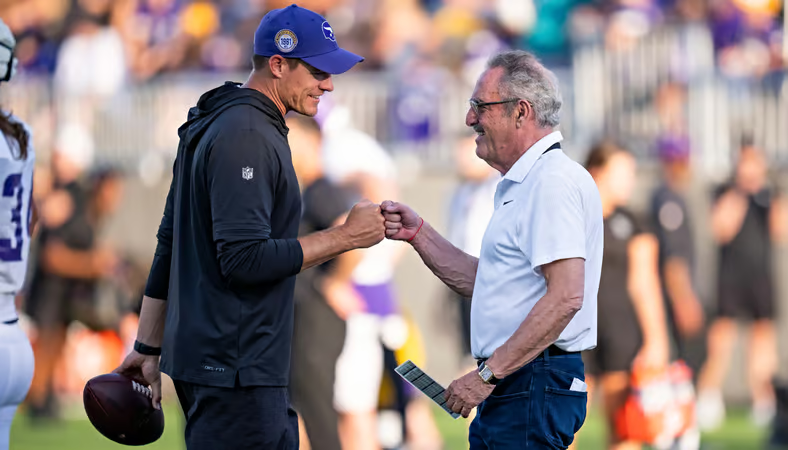
Again, I’m not calling for Kevin O’Connell to be fired. He’s earned the opportunity to fix this, and being 3–0 actually gives him plenty of breathing room to do it. But I also don’t think we can get to the end of this season, look at the win–loss column and judge him purely on that.
Let’s say Minnesota finishes 11–6 or 12–5. Great season. But what if the defense has carried much of the load again and the offense still looks like this when January arrives? At some point, playoff performance has to matter.
If the offense develops, Murray settles in and Minnesota finally turns regular-season success into playoff wins, then O’Connell will have answered a lot of these questions. And he should get the credit for doing so.
But if January comes around and we’re watching the same offensive problems, still questioning the quarterback position and watching another early playoff exit, then I think the Wilfs have a serious decision to make.
With great responsibility comes great scrutiny
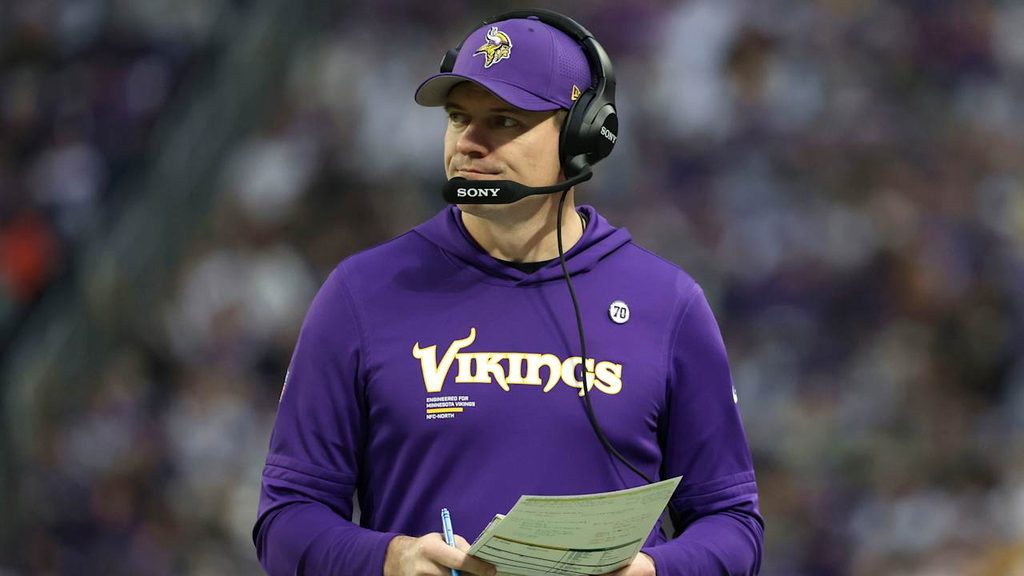
O’Connell’s influence within the organisation has grown. His fingerprints are increasingly on personnel decisions. The quarterback position and offensive scheme are unquestionably his responsibility. With that comes scrutiny.
Minnesota spent the 10th overall pick on McCarthy and moved on after 10 starts. There are questions about how he was developed and how the quarterbacks were handled generally. They’ve now replaced him with a quarterback who doesn’t appear an obvious fit for O’Connell’s preferred offense, wasted valuable summer reps on a QB competition, and started the season 3–0 despite the offense still searching for an identity.
You can probably explain every one of those things individually. It’s when you put them all together that I start to worry. So yes, we’re 3–0, but I’m not going to pretend everything’s fine just because the record says it is. There’s a long season ahead and Kevin O’Connell has plenty of time to prove these concerns wrong.
But if we arrive in January and we’re still having this same conversation after another playoff disappointment, then I think the Wilfs have to ask a question that sounds ridiculous when you’re sitting at 3–0: is Kevin O’Connell still the right man to take the Minnesota Vikings forward?
Right now, I don’t know the answer, but I do think it’s becoming a fair question to ask.
Do you have thoughts about the direction the Vikings are going this season? Want to share those thoughts with the rest of the UK & Ireland fandom? Get in touch with us via email at UKVikingsFanClub@gmail.com or drop us a DM on any of our social media channels.