

Darren Hails digs into the Saints win and the first five games of PFF data, looking at the tight ends who stepped in, the protection that held up and the pressure behind a quiet sack total.
Week 5: Vikings 23–13 Saints · Regular-season data through 11 October 2026
Grades and charted data are from PFF Premium Stats. Season rates are calculated from the weekly reports. PFF records one more passing yard for Murray in this game than the published box score; passing splits below follow its charting.
Five wins, a bye to catch our breath and finally a game with two offensive touchdowns. We’ll take that. But losing T. J. Hockenson on the opening drive meant the Saints game also asked something of players whose names don’t usually lead the discussion.
Gavin Bartholomew and Ben Yurosek finished with 43 receiving yards between them. That sounds fairly modest until we separate what each was being asked to do. Elsewhere, Brian O’Neill’s overall grade concealed much better work in protection, and Eric Wilson helped wreck New Orleans’ passing game without recording a sack.
Part 1: Inside the New Orleans game
Bartholomew and Yurosek filled different parts of the gap
T. J. Hockenson played only two offensive snaps, leaving after his opening-drive catch. Gavin Bartholomew finished with 44 offensive snaps and 25 routes, while Ben Yurosek played 39 snaps and ran 10 routes. Those snap totals can overlap when both are on the field; they aren’t 83 separate plays replacing Hockenson.
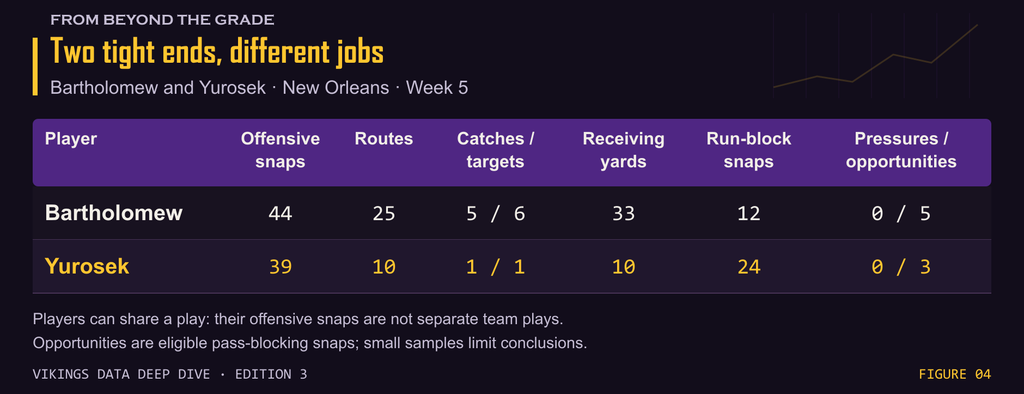
Bartholomew was the more frequent receiving option: six targets on 25 routes (24.0%), compared with one on ten (10.0%) for Yurosek. His five catches produced 33 yards and two receiving first downs, with no drops. The intriguing detail is that all 33 yards were charted after the catch. Across those completed passes, the net yardage at the catch point was therefore zero. His 3.8-yard average target depth includes the incompletion too, so it doesn’t contradict that finding.
That doesn’t mean every catch came exactly on the line of scrimmage, or that these were all screens. It does show that Bartholomew’s receiving return depended on gaining ground after securing the ball. Five catches for 33 yards looks fairly ordinary on a box score; having to generate the whole net total after the catch tells us more about how he helped.
Yurosek’s workload leaned the other way. He had 24 run-blocking snaps to Bartholomew’s 12, lined up inline on all 15 of his passing snaps, and caught his only target for 10 yards and a first down. Bartholomew’s passing alignments were more varied: 15 slot snaps, 6 wide and 10 inline out of 32 passing snaps. They weren’t simply taking turns doing an identical job.
Protection held up in their limited opportunities. Bartholomew allowed no pressures on five eligible pass-blocking opportunities; Yurosek allowed none on three. Their pass-block grades were 67.6 and 73.2 respectively. Run-block grades of 57.9 and 61.4 give us less reason to celebrate that part of the afternoon. I’d call this a useful response to losing Hockenson – reliable catches, three receiving first downs between them and no credited protection breakdowns – rather than proof that his absence went unnoticed.
O’Neill’s overall grade hides the protection he supplied
The Vikings’ game report led with Aaron Jones’ running, while Judd Zulgad highlighted the offense’s progress. The less comfortable detail is that Jones gained 87 of his 113 rushing yards after contact (77.0%). His initial room fell from 2.60 yards per carry against Miami to 1.04 in New Orleans. We’ll return to that in the season numbers, but a hundred-yard runner doesn’t establish that the blocking was strong across the board.
O’Neill illustrates why the individual jobs need separating too. His 59.0 overall grade sits alongside an 85.3 pass-block grade and a 44.3 run-block grade. He allowed no pressures across 39 eligible protection opportunities. That’s a substantial workload, particularly alongside the tight ends’ much smaller samples.
On the same 39 eligible opportunities apiece, Joe Huber allowed one pressure, Ryan Van Demark two, Blake Brandel two and Will Fries two, including a sack. Those credits shouldn’t be added together to reconstruct Murray’s pressured dropbacks: pressure can involve multiple players or be charged elsewhere. They do identify O’Neill as the starting lineman who finished without an allowed pressure.
The passing improvement had help from a familiar player doing a less visible job. His low run-block grade still belongs in the assessment, but judging his protection from the overall number would miss one of the better contributions of the afternoon.
One sack, twelve pressured dropbacks and no first downs
Saints quarterback Tyler Shough faced pressure on 12 of his 27 dropbacks (44.4%). Minnesota converted only one into a sack, but the other outcomes explain why the defense could dominate without a big sack total.
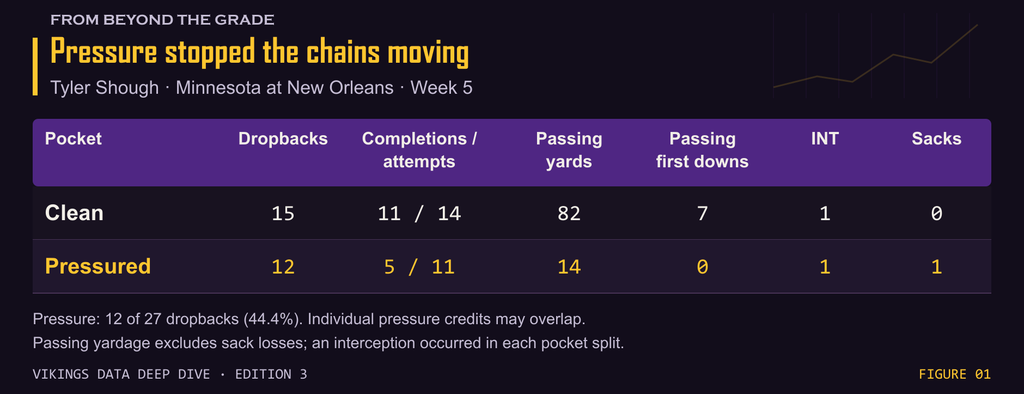
Five pressured completions produced just 14 yards and no passing first downs. That’s 1.27 yards per attempt, before counting the sack loss. The completions weren’t rescuing New Orleans from the disruption. Clean-pocket throws produced 82 yards and all seven passing first downs, although Shough also threw an interception from a clean pocket, so pressure doesn’t explain both takeaways.
Eric Wilson supplied five individual pressure credits on 14 rushes (35.7%), with all five coming on his eight true-pass-set rushes. Turner added four on 26 rushes, and Van Ginkel three on 13. Those individual credits can overlap on a play; they aren’t numbers to add up and call the team’s pressure count. Wilson’s workload-adjusted contribution was particularly strong, even without a sack beside his name.
Rookie watch: Golday’s contribution came on special teams
Jake Golday’s 91.1 special teams grade on 17 snaps is the eye-catching rookie number this week. He recorded one tackle, but had no defensive snaps in the report. The grade recognises work beyond the tackle count; these tables don’t identify every block or assignment behind it. It’s encouraging evidence from the kicking units, while his role in the defense remains a separate question.
Max Bredeson had the larger offensive workload among the 2026 draft picks: 20 snaps, including 15 run-blocking snaps, without a carry or receiving target. His 58.6 run-block grade leaves room for improvement. A 74.4 pass-block grade and no pressures allowed came from just two eligible opportunities, so that stronger number needs a “very small sample” label. His contribution was being asked to block, rather than accumulating touches.
Caleb Banks played seven defensive snaps and Domonique Orange five. Each had four snaps against the run; Banks recorded one run stop, meaning a tackle PFF judged a failure for the offense. Neither generated pressure, but Banks had only three rushes and Orange one. Four combined rushes without a pressure tell us much more about their limited opportunity than their ability to disrupt a quarterback. Banks’ one stop on four run snaps is a promising individual result, not yet a reliable success rate.
Demond Claiborne caught his only target for six yards in four offensive snaps, with no carries. Caleb Tiernan’s three offensive snaps were all in a run-blocking role, giving us no pass-protection evidence from this game. The rookie contribution was spread across small jobs; Golday’s special teams work stands out, but most of this group still needs a larger workload before we can make much of the grades.
Part 2: What the first five games now tell us
The running average is rising, but the initial space isn’t
Aaron Jones heads into the bye with 410 yards on 97 carries, or 4.23 yards per carry. That average has risen from 3.90 after Tampa Bay, but the contact breakdown gives us a more cautious view of what’s improving.
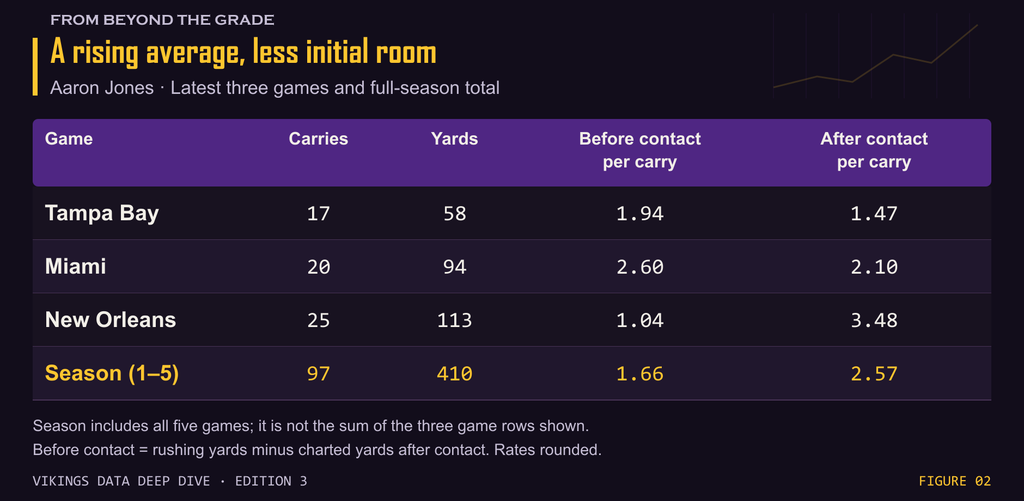
Across the last two games, his after-contact average has improved each week. His space before contact rose against Miami and then fell sharply against the Saints. Adding New Orleans actually lowers his season before-contact average from 1.88 to 1.66, while lifting his after-contact average from 2.25 to 2.57.
The run game is getting a better final return, but this week weakens the idea that Miami marked the start of consistently better initial running room. Jones helped sustain the improvement when that room disappeared. Keeping the carries productive under those conditions is encouraging; needing him to do so regularly is a different proposition.
More receiving help, but Jennings’ involvement keeps shrinking
With Hockenson departing and Addison unavailable, the Saints game offered a test of the other receiving options. Bartholomew and Yurosek supplied six catches, 43 yards and three receiving first downs. Jeshaun Jones added a 32-yard catch on his only route, in just six offensive snaps. Useful contributions, although one route tells us very little about whether Jeshaun could sustain that production in a larger role.
Jennings went the other way: 28 routes, one target and no catches. Across the first five games, he now has 118 routes, five targets and two catches for nine yards. His target frequency has slipped from 4.4% through Miami to 4.2%, and his season yardage hasn’t moved. Those are receiving figures, not a complete judgement of everything he does on the field, but the lack of involvement is becoming harder to overlook.
For comparison, Jefferson has 258 yards on 94 routes and Hockenson 202 on 102. That works out at 2.74 and 1.98 yards per route respectively, against 0.08 for Jennings. Roles, coverage and quarterback choices influence those returns; the reports can’t tell us who was open on every play. Even allowing for those differences, Minnesota is getting almost no receiving yardage from a player repeatedly running routes.
Murray’s clean-pocket improvement has continued – 41 completions on 48 attempts for 359 yards over the last two games – but the supporting cast hasn’t contributed evenly. The backup tight ends gave the offense useful alternatives this week. Jennings’ five-game record still leaves a sizeable gap.
The screens gained more yards and still didn’t move the chains
Minnesota completed all eight screens against New Orleans for 54 yards, its largest screen-yardage total of the season. It also recorded zero passing first downs from them, taking the five-game total to 21 completions on 25 attempts for 121 yards, without a first down.
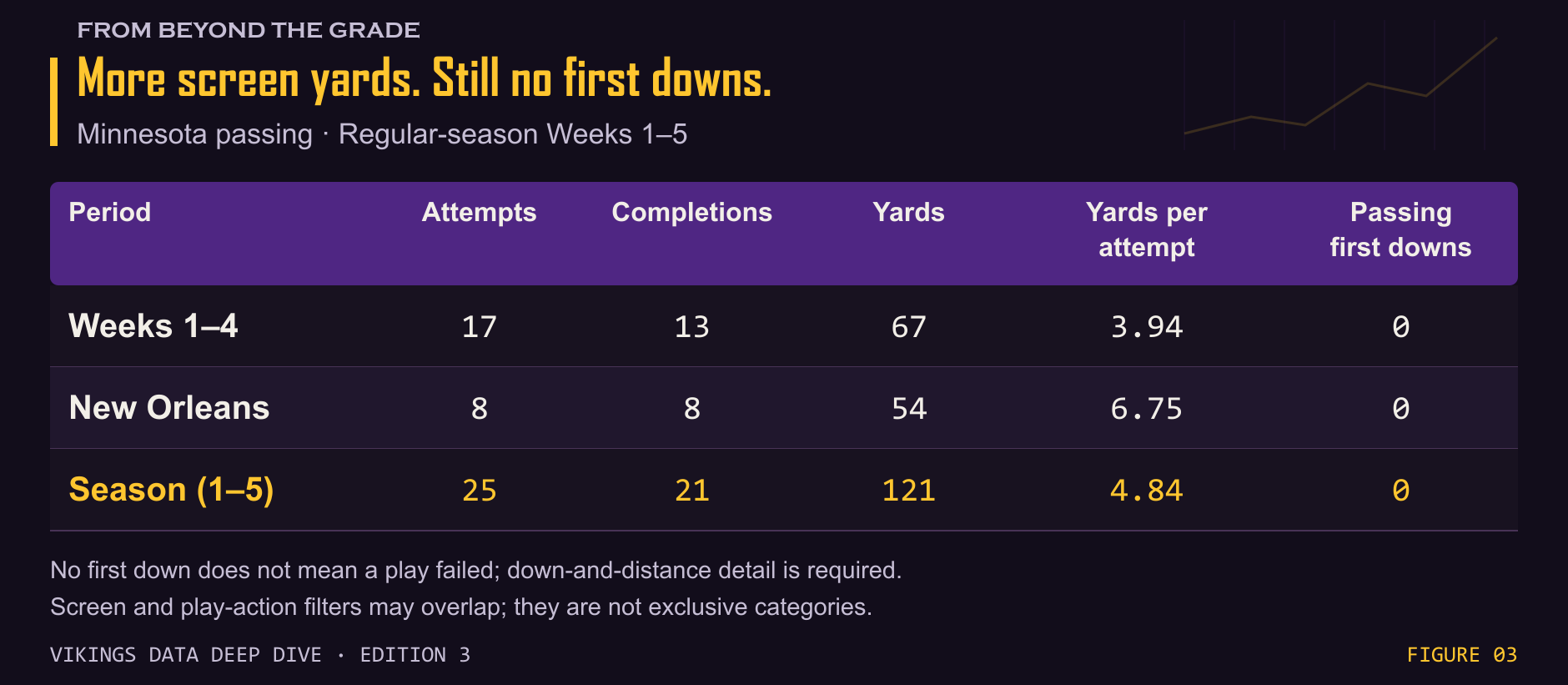
That deserves a more precise judgement than calling every screen useless. A six-yard gain can make the next play easier without earning a first down itself. These reports don’t supply the down-and-distance detail needed to judge that consistently, but the increase in yardage hasn’t changed the specific weakness we’ve tracked: the screen passes still aren’t converting directly into new sets of downs. All 13 passing first downs against the Saints came on non-screen attempts.
Rookie season watch: regular jobs, limited expansion
Golday has now played 84 special-teams snaps, with weekly workloads of 19, 15, 15, 18 and 17. His Saints performance came within an established role rather than a sudden increase in opportunities. On defense, he has just seven snaps all season: two against Tampa Bay and five against Miami. Sunday’s special-teams success hasn’t yet coincided with a sustained defensive role, and we shouldn’t assume one will automatically lead to the other.
Banks and Orange have had more defensive work, but their involvement has narrowed. Banks’ weekly snap counts are 16, 36, 12, 11 and 7, for 82 overall. Orange’s are 22, 24, 13, 14 and 5, totalling 78. Neither has returned to his opening two games’ workload. Game length and personnel choices affect raw snaps, so this isn’t proof they’ve been dropped down the pecking order; it does mean the last three games have given us fewer opportunities to judge them.
Across those five games, Banks has three pressures on 45 rushes (6.7%) and Orange one on 34 (2.9%), with no sacks for either. All four pressure credits came in Weeks 2–3. Their lack of pressure since then covers only eight rushes for Banks and seven for Orange. That’s a quieter return, but a very small recent sample rather than evidence of a prolonged slump.
Bredeson has the most consistent offensive foothold of this group: 85 offensive snaps, including 57 in a run-blocking role. His workload fell from 24 in the opener to 10 in Week 3, then recovered to 14 and 20. He’s getting regular work, although the latest run-block grade doesn’t establish that more involvement has brought better execution. Through the bye, the clearer rookie pattern is a handful of established supporting jobs, with substantial offensive or defensive roles still to be earned.
After the bye, I’d like to see whether the tight ends retain some of that involvement when Hockenson returns, and whether Jennings can turn his route workload into a receiving contribution. Wilson’s pressure production and O’Neill’s protection deserve tracking too. This team has enough interesting work going on beyond its most familiar statistical names to keep us busy.