

Darren Hails digs into the Colts win and six games of PFF data, finding more to Cashman’s afternoon than sacks, progress from Joe Huber and a small breakthrough in the passing game.
Week 7: Vikings 16–10 Colts · Six regular-season games through 25 October 2026
Grades and charted statistics are from PFF Premium Stats. Game comparisons use the weekly reports; season assessments also use the cumulative reports. Week 6 was Minnesota’s bye. Season grades are taken directly from those reports, never averaged from weekly grades.
Six wins from six, and another afternoon when the defense had to finish the job. Harrison Smith’s interception will rightly be remembered, as will Blake Cashman’s two sacks. But Cashman’s work when he wasn’t rushing deserves just as much attention, while an offensive lineman who struggled badly against Miami has now put together a much more encouraging run of protection.
We’ve also got something to correct from the previous edition. Jennings’ receiving total has finally moved, and the screens have finally produced a first down. Neither development fixes the offense, but this series ought to recognise progress as carefully as it picks apart the problems.
Part 1: Inside the Indianapolis game
Cashman caused problems whichever job he was given
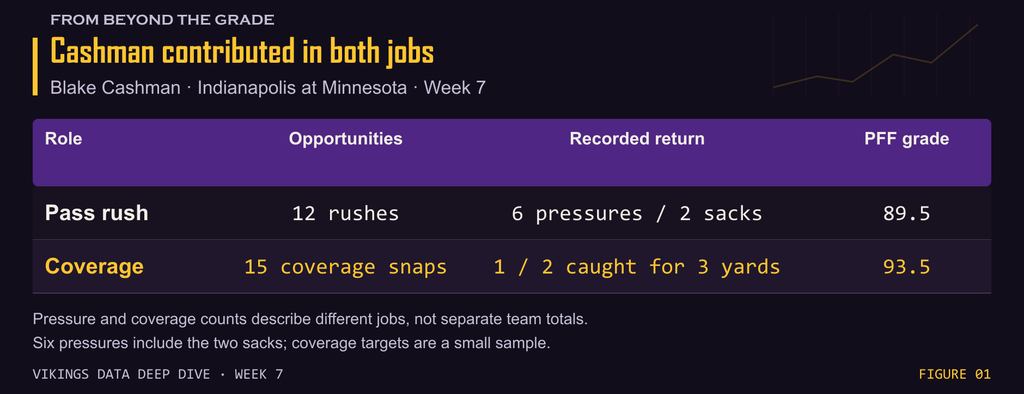
Cashman generated six pressures on 12 rushes (50.0%), including two sacks and a quarterback hit. That’s an exceptional return from a player who also spent 15 snaps in coverage. Five of those pressures came on nine true-pass-set rushes, the filter that removes plays such as screens and play action. His disruption wasn’t confined to the broader mixture of passing situations.
The coverage work is the less obvious part. Two targets into his coverage produced one completion for three yards. His 93.5 coverage grade sits alongside an 89.5 pass-rush grade and a 94.9 overall defensive grade.
He also finished without a missed tackle, with seven solo tackles and two assists across 58 defensive snaps. The sacks were part of an afternoon in which he contributed in several different ways, rather than two spectacular moments carrying an otherwise ordinary performance.
Smith supplied a different kind of efficiency: 31 defensive snaps, three rushes, two pressures and a sack, alongside the interception. Three rushes are nowhere near enough to project a sustainable pressure rate, but they show how much he managed to fit into a restricted workload. Cashman did his damage across a much larger afternoon; Smith’s interventions came from fewer opportunities.
Huber held up while the protection problems moved elsewhere
Joe Huber played all 59 offensive snaps, allowing one hurry on 30 eligible pass-blocking opportunities. His 82.8 pass-block grade was the highest among Minnesota’s starting linemen. That’s a welcome result for a player whose first extended appearance in this run of games was much less comfortable.
The starting tackles held up well too. Brian O’Neill allowed one hurry and Christian Darrisaw one sack, each across the same 30 eligible opportunities. Both received 81.0 pass-block grades. Inside, Will Fries and Blake Brandel each allowed two hurries, but their pass-block grades were 37.0 and 27.0 respectively.
That difference is a reminder that a pressure count doesn’t describe every protection rep. Darrisaw’s one allowed sack doesn’t make his whole afternoon worse than a lineman who conceded no sacks; grades evaluate the wider work, including defeats that don’t become a recorded pressure. Nor should the individual pressure credits be summed and treated as Murray’s pressured dropbacks, because multiple players can contribute to the same play.
The backs supplied less reassurance. Jordan Mason allowed a hurry on four eligible protection opportunities, while Max Bredeson allowed a hit on his only one. Those are tiny samples, but they help explain why returning offensive personnel didn’t mean every part of the passing operation suddenly became comfortable. Huber’s progress deserves recognition within that uneven picture.
The clean-pocket improvement didn’t survive this game
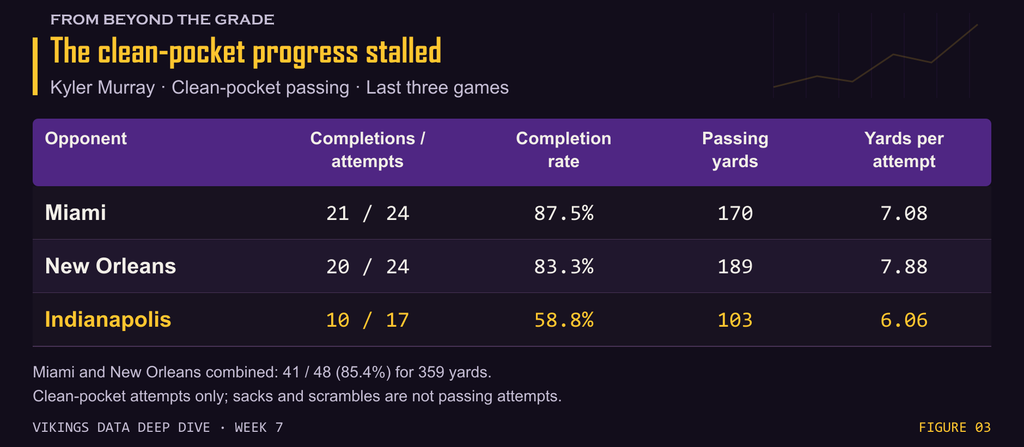
After Miami and New Orleans, we had good reason to be encouraged by Murray’s clean-pocket passing. Against Indianapolis, 10 completions on 17 clean-pocket attempts produced 103 yards, with a 38.5 passing grade and one turnover-worthy play. The previous two games had supplied 41 completions on 48 such attempts. This was a substantial step backwards in the conditions where he’d recently been most reliable.
Under pressure, he completed four of seven attempts for 47 yards, with one big-time throw, no turnover-worthy plays and a 79.6 passing grade. That doesn’t make pressure desirable: those 12 pressured dropbacks also contained three sacks and two scrambles. It does prevent us from explaining his entire throwing performance as the inevitable consequence of defenders getting through.
The final line was 14 completions on 24 attempts for 150 yards and a touchdown. Two recorded drops contributed to the incompletions, but a 53.2 overall passing grade leaves plenty that can’t be put on the receivers. Murray supplied important work with his legs; the throwing improvement we’d hoped would continue after the bye didn’t carry over consistently.
Rookie watch: Golday got defensive work, but special teams went backwards
Jake Golday played nine defensive snaps, his largest workload of the season, although eight were against the run and only one was a rush. He had an assisted tackle and no pressure. This was more involvement, but it wasn’t a broad test of his coverage or pass-rushing ability.
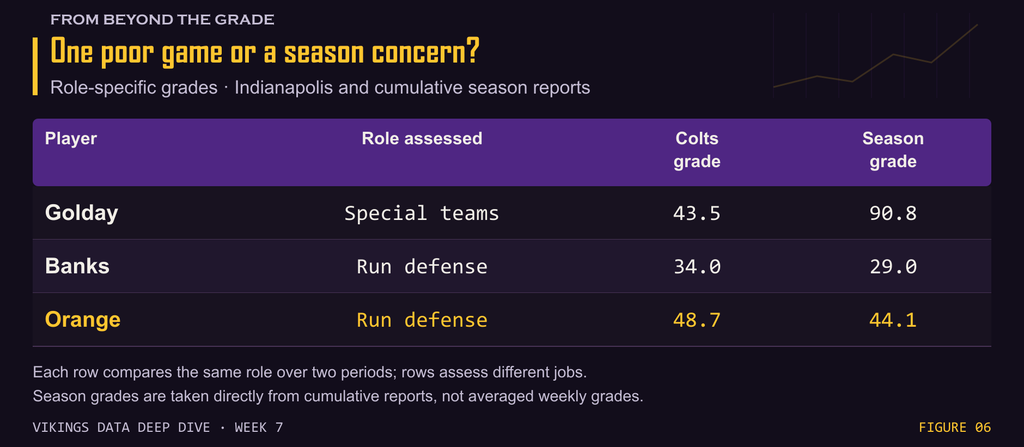
His 17 special-teams snaps produced a 43.5 grade and a penalty, following the 91.1 grade against New Orleans. That’s a sharp change in the weekly assessment. His cumulative special-teams grade is still 90.8, though, so this was a poor afternoon within a strong season rather than a reason to dismiss his earlier contribution.
Caleb Banks played 12 defensive snaps and Domonique Orange 13. Each had nine run-defense snaps; Banks’ 34.0 run-defense grade and Orange’s 48.7 were disappointing. Orange generated a hurry on four rushes but also missed a tackle. Banks had no pressure on three rushes. Those opportunities remain too scarce to make confident claims about their pass-rush development, while the run work gives us less reason for optimism this week.
Part 2: What six games now tell us
Huber’s improvement is becoming more than one good afternoon
Huber’s pass-block grades over his last three games are 32.2 against Miami, 49.7 against New Orleans and 82.8 against Indianapolis. More usefully, we can set those assessments beside what actually happened: two hurries on 39 eligible opportunities, then one hit on 39, then one hurry on 30.
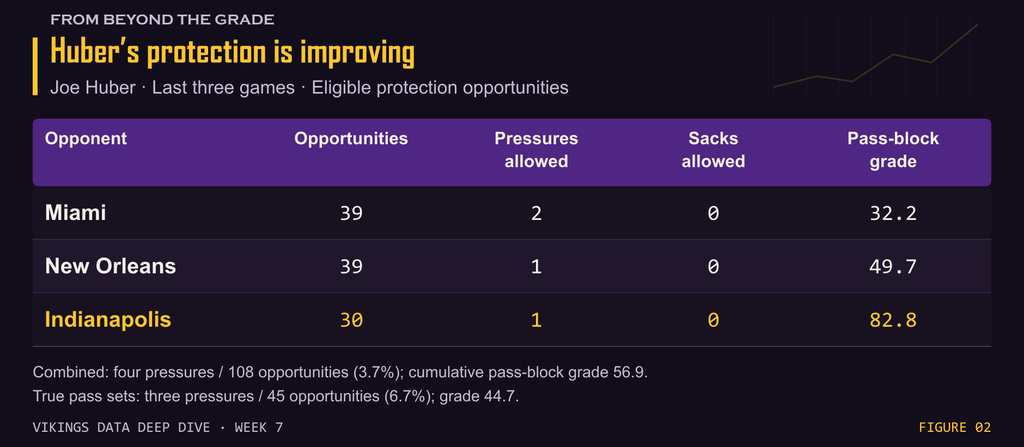
That’s four pressures allowed on 108 eligible opportunities (3.7%), with no sacks charged to him in those games. The fairly modest change in pressure totals sits alongside a much larger improvement in the grades, suggesting his work between the recorded pressures has become more convincing too.
The cumulative report supplies a useful brake on the excitement: his pass-block grade across those three appearances is 56.9, falling to 44.7 on true pass sets. That filter strips out plays including screens and play action. Three of his four allowed pressures came on 45 eligible opportunities in that subset: 6.7%, compared with 3.7% overall. The remaining opportunities produced one pressure on 63 (1.6%).
Those are different situations, not a controlled test of scheme or help. They do show why a low overall pressure rate and a less convincing protection grade can coexist. Huber’s latest performance is encouraging, but the harder passing situations remain a question. I would stop treating Miami as the only evidence available without declaring the left-guard problem solved.
Jennings finally gave us a different number to discuss
Jennings entered Sunday with two catches for nine yards on 118 routes. Against Indianapolis, two catches on three targets produced 34 yards and two receiving first downs, from 19 routes. He gained 24 yards after the catch, so this wasn’t simply a couple of longer throws inflating his return.
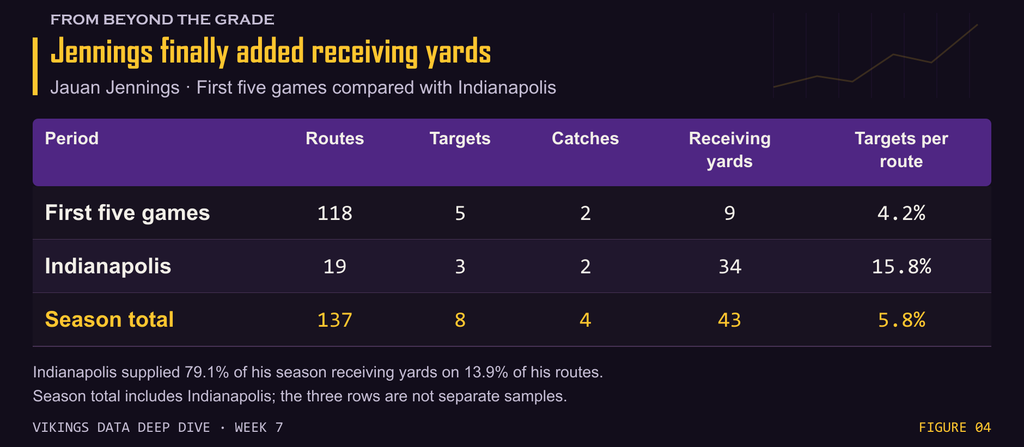
His target frequency rose from five targets on 118 routes (4.2%) before the game to three on 19 (15.8%) in it. He now has four catches for 43 yards on 137 routes, or 0.31 yards per route. That remains a low season return, but Sunday supplied 79.1% of his receiving yards on just 13.9% of his routes.
One game has done most of the work in making that season total look less bleak. We’ve seen him contribute; what we haven’t seen is repeated involvement. That’s a fairer position than either declaring the problem solved or continuing to quote the nine-yard total as though nothing happened.
The tight-end workloads changed too. With Hockenson back for 45 offensive snaps and 20 routes, Bartholomew fell from 44 snaps and 25 routes against New Orleans to seven and two. His only target still became a 17-yard catch, including 15 after the catch. He made useful use of a much smaller role; we shouldn’t read his 73.5 overall grade as though he’d repeated the Saints workload.
A screen finally moved the chains
Through five games, Minnesota’s screens had produced 21 completions on 25 attempts for 121 yards and no passing first downs. Against Indianapolis, the screen split recorded one completed attempt for 11 yards and a first down.
That takes the season to 22 completions on 26 attempts for 132 yards and one first down, or 5.08 yards per attempt. One first down on 26 attempts (3.8%) is still a limited direct return in new sets of downs, but the zero we’ve followed since the opening edition has gone.
The reports don’t give us enough down-and-distance detail to label every other screen a failure. What has changed is narrower and worth acknowledging: this time the completion moved the chains. We need more of that before a single successful attempt becomes a convincing season pattern.
Rookie season watch: opportunities are growing in small steps
Golday’s 90.8 season special-teams grade gives us a much stronger overall assessment than his Colts performance alone. His defensive workload stands at 16 snaps, nine of them against Indianapolis – more than in his first five games combined. That’s increased involvement, although the latest run-heavy assignment hasn’t yet demonstrated a sustained all-round defensive role.
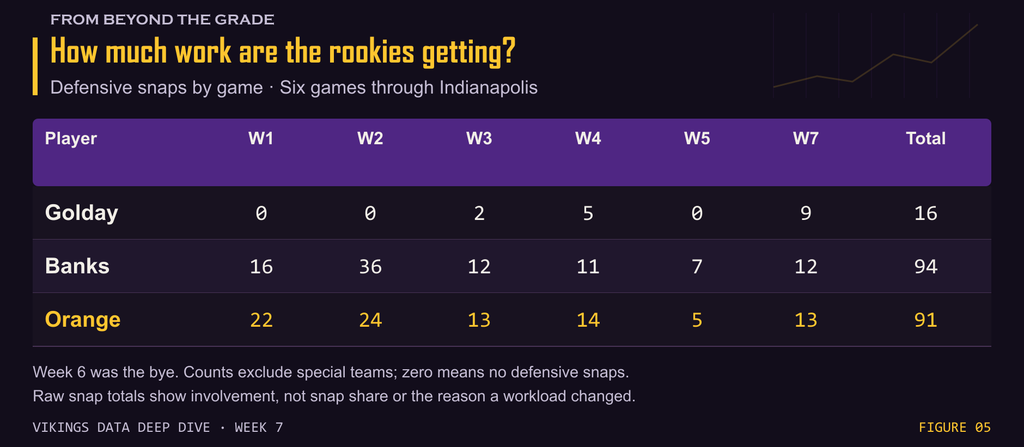
Banks is up to 94 defensive snaps, Orange 91. Their workloads recovered from seven and five respectively against New Orleans to 12 and 13, but remain below their opening two games. Banks has three pressures on 48 season rushes (6.3%); Orange has two on 38 (5.3%). Neither has a sack. Orange’s latest hurry ended his run of games without a pressure, while Banks’ last pressure remains in Week 3.
The cumulative grades make the concern about the two defensive tackles firmer. Banks has a 29.0 run-defense grade across 46 run-defense snaps; Orange is at 44.1 across 53. Their overall defensive grades are 30.2 and 42.9 respectively. These are still limited workloads, but the disappointing run work against Indianapolis fits their season assessments rather than being an isolated bad day.
Bredeson has played 96 offensive snaps, 64 in a run-blocking role. His latest 11 snaps didn’t extend the increase we saw before the bye, and a 54.4 run-block grade offered little evidence of better execution. The rookies are getting jobs, but the data still gives us considerably more evidence about limited supporting roles than established starting-quality production.
The next useful step would be Jennings repeating his involvement, Huber maintaining his protection and Golday getting another meaningful defensive assignment. Six wins give Minnesota a very good position to work from. These are some of the smaller contributions that could make the next one less dependent on another defensive rescue.