

Detroit exposed the distance between reaching the ball-carrier and finishing the tackle, while the passing numbers reveal a much more specific problem than simply saying Kyler Murray can’t hit his receivers.
Week 8: Lions 19–15 Vikings · Seven regular-season games through 1 November 2026
Grades and charted statistics are from PFF Premium Stats, using game reports and season exports captured on 2 November. League player comparisons below use the stated workload cut-offs; they aren’t PFF’s default qualified-player rankings. Week 6 was Minnesota’s bye.
The unbeaten run is over, and the frustrating thing about Detroit is that some of what went wrong was already there in the numbers. I’ve watched this defense keep the Vikings in games, deservedly praised it and still found myself asking why quite so many tackles aren’t being finished.
Sunday gave that concern a fairly unpleasant answer. It also gave me another difficult afternoon watching Murray, although the passing breakdown needs more care than the completion percentage alone allows. There’s a substantial weakness in this offense, but calling every incomplete pass an accuracy problem would miss where it’s happening.
Part 1: Inside the Detroit game
The Lions gained less room, then did more damage
Jahmyr Gibbs and Sione Vaki combined for 218 rushing yards on 34 carries. Of those yards, 180 came after contact (82.6%). That leaves 38 net yards before contact, or just 1.12 per carry.
Compare that with the same two backs across Detroit’s previous six games. They’d averaged 1.51 yards before contact and 3.00 afterwards. Against Minnesota, their initial room shrank, but their after-contact return jumped to 5.29 yards per carry.
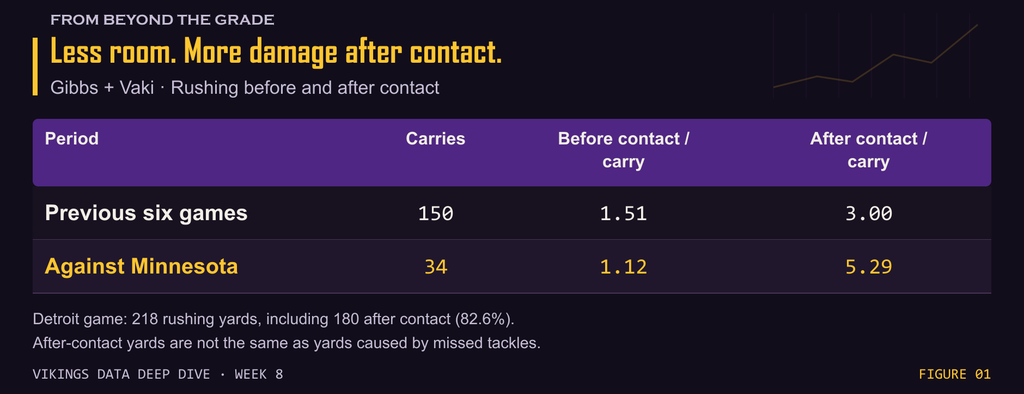
That’s a more specific failure than Detroit simply opening enormous holes. Minnesota was making contact early enough to give itself a chance, and the backs were still producing huge gains afterwards. After-contact yardage includes the yards a runner gains while being brought down, so it can’t all be labelled missed-tackle yardage. But Gibbs forced ten missed tackles and Vaki four, while Eric Wilson and Josh Metellus each recorded three run misses. There’s plenty here beyond a misleading average.
Nor can I explain it away with a couple of long runs. Gibbs’ three breakaway carries supplied 66 yards; remove them from the pair’s combined total and Detroit still gained 152 yards on 31 carries (4.90 per carry). The damage kept coming.
The protection deserves credit, even if the passing didn’t
Detroit entered this comparison with the league’s third-highest season pass-rush grade. Aidan Hutchinson nevertheless finished with one pressure on 33 rushes, compared with 42 on 274 before Sunday. That’s a drop from 15.3% to 3.0%.
Brian O’Neill, Blake Brandel and Joe Huber each allowed no pressures on 33 eligible pass-blocking opportunities. Huber’s 70.5 pass-block grade adds another encouraging game to his recovery. Will Fries and Christian Darrisaw each allowed a sack, so this wasn’t flawless, but it deserves better than being bundled into a general complaint about the offense.
Murray completed 17 of 23 clean-pocket attempts for 210 yards and two touchdowns. Under pressure, he went zero for six, with an interception, while the other three pressured dropbacks ended in sacks.
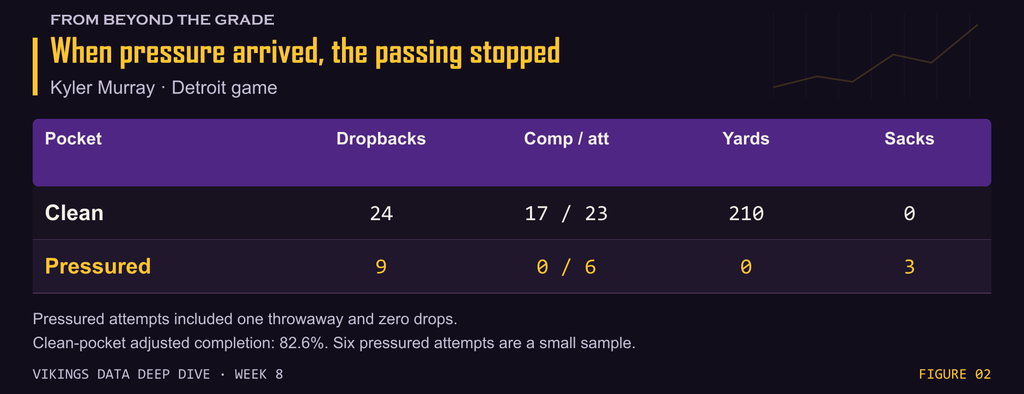
His clean-pocket adjusted completion rate was 82.6%, accounting for drops and excluding certain non-aimed throws. There were no drops on the pressured attempts, although one was a throwaway. Six attempts are a small sample, but the cost was enormous: every pressured passing attempt ended without a completion, despite pressure arriving on only 9 of 33 dropbacks (27.3%).
The Colts game had produced the opposite grading split: poor clean-pocket passing and a much better pressured assessment. I’m still not seeing a dependable answer to disruption, but I’m also not seeing evidence of a quarterback who was inaccurate on everything he threw in Detroit.
Rookie watch: the tackling problem reaches beyond the rookies
Domonique Orange played 26 defensive snaps, including 19 against the run; Caleb Banks played 13, including eight against the run. Neither recorded a run stop or a missed tackle. Their run-defense grades were 40.4 and 57.1 respectively.
Zero missed tackles doesn’t clear them. A defender who never reaches a useful tackling position may have a poor rep without recording a miss, and the grades don’t identify precisely which assignment failed. Equally, the six run misses from Wilson and Metellus mean the experienced players can’t disappear from this discussion.
Jake Golday’s defensive workload fell from nine snaps against Indianapolis to four, all against the run. His 21 special-teams snaps brought a 49.7 grade and a penalty. That follows a 43.5 special-teams grade against the Colts, making two disappointing games; his season figures give a considerably kinder assessment.
Part 2: What I’m seeing after seven games
The scoring record has been covering for the tackling
Minnesota has allowed 93 points in seven games (13.29 per game), the lowest average in the league table. Those are team points allowed, including any points charged outside the defensive unit. It’s still an excellent result, and there’s no need to pretend otherwise because the Vikings have lost once.
The underlying assessments are less flattering: 15th in overall defense, 16th in pass rush, 19th in coverage and 27th in tackling. Run defense grades 11th.
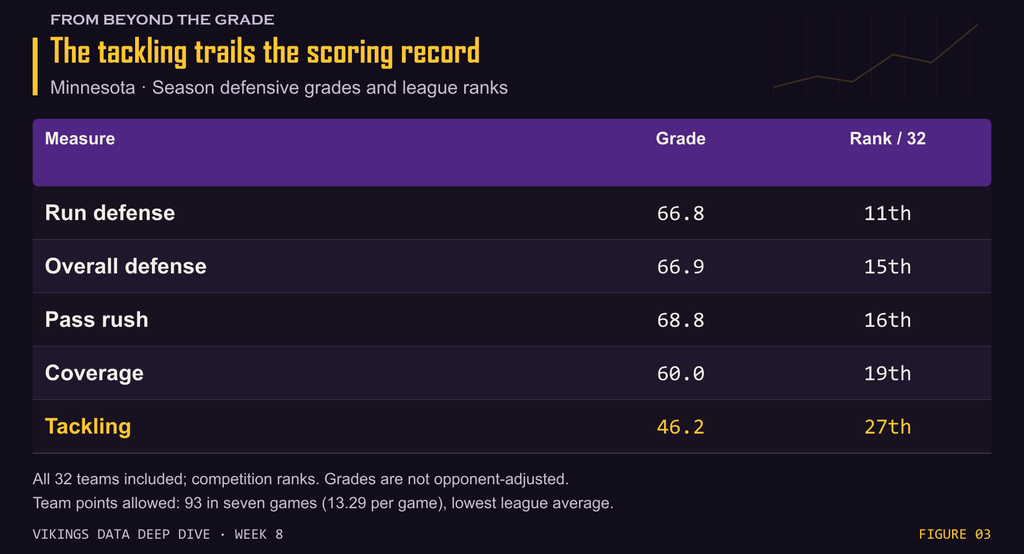
That supports a concern I’ve had for a while. The defense has helped win games while carrying a tackling weakness. Detroit’s season tackling grade ranks first, its run blocking fourth and its offense second, so Sunday tested Minnesota against a genuinely strong opponent rather than an ordinary offense having an inexplicable afternoon.
Wilson’s 30.0 tackling grade ranks 71st of 72 linebackers with at least 200 defensive snaps. Cashman’s 74.1 ranks 14th under the same cut-off. The problem isn’t shared equally across the group, and treating it that way would let the weaker performances off rather lightly.
Against better offenses, missed tackles offer extra yards without requiring the quarterback to beat the coverage again. Detroit supplied a particularly clear example. The season numbers say this concern survives beyond one bad Sunday, even if they don’t prove the tackling has worsened every week.
Murray’s missing completions are concentrated in the middle
Murray’s season completion percentage is 64.9%, ranking 15th among 33 quarterbacks with at least 100 attempts. His adjusted completion rate is 76.4%, ranking 12th. Neither figure supports describing him as one of the league’s least accurate passers across all situations.
Split the throws by depth, though, and the problem becomes much harder to ignore.
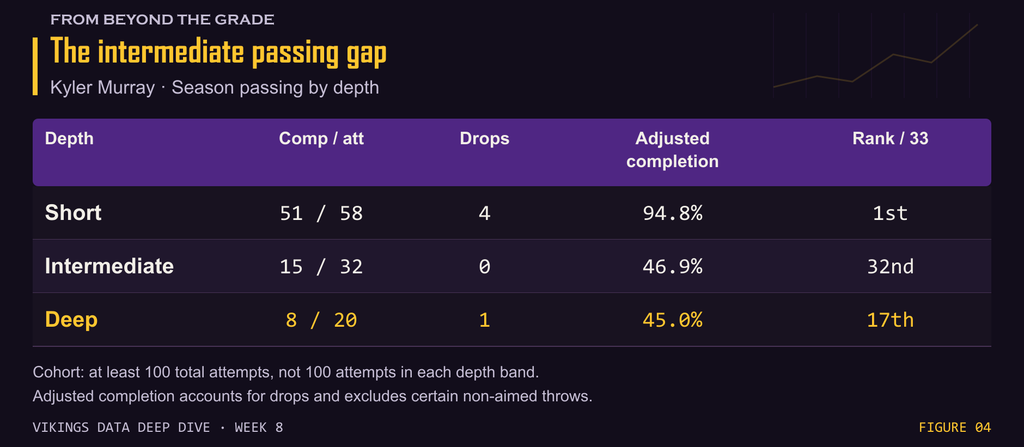
On intermediate throws, 15 completions from 32 attempts, with no drops, leave him at 46.9% adjusted completion: 32nd of those 33 quarterbacks. His intermediate passing grade ranks 27th. Drops aren’t explaining the missing production there.
Short passing is almost the reverse: 51 completions on 58 attempts, plus four drops, produce a 94.8% adjusted rate, highest in the same cohort. Deep adjusted completion sits 17th. The minimum is 100 total attempts, so individual depth samples remain smaller and vary between quarterbacks.
Adjusted completion isn’t a direct ball-placement measurement. Coverage, separation and decisions still affect whether a pass is caught. Even with that qualification, the intermediate results are poor enough to support criticism without overstating it. Minnesota can complete the short throws; too much of the passing game between those and the deep shots is failing to produce.
There’s also an encouraging individual return inside the wider frustration. T.J. Hockenson’s 82.8 receiving grade ranks second of 39 tight ends with at least 100 routes, while his 2.03 yards per route ranks fifth. He’s caught all eight contested targets. The offense’s receiving grade ranks 23rd, but Hockenson’s season work is substantially better than that collective assessment.
Rookie watch: an uneven interior, and a better Golday season
The complete league data helps separate the young tackles’ problems from the players beside them. Among 133 interior defenders with at least 50 run-defense snaps, Jalen Redmond ranks first and Levi Drake Rodriguez 14th. Orange ranks 121st and Banks 131st.
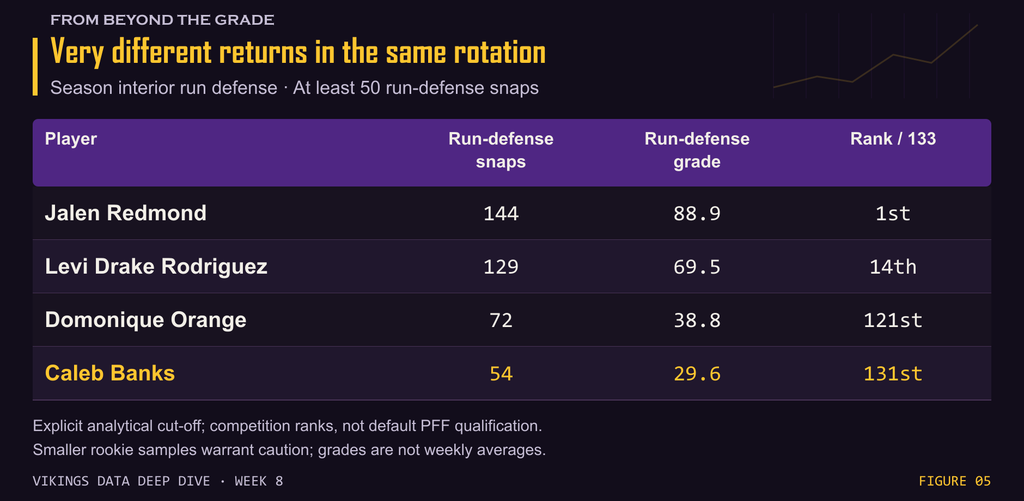
That’s an exceptionally uneven rotation. The rookies have smaller samples, and the cut-off is deliberately inclusive enough to retain both, but their results are weak relative to their position. Redmond and Rodriguez deserve credit rather than being dragged into a blanket judgement about the interior.
Golday offers the opposite warning against letting the last game become the whole season. His cumulative special-teams grade is 90.3, seventh of 506 players with at least 50 special-teams snaps, across 133 snaps. The two recent penalties and poor weekly grades need correcting, but they haven’t erased a strong overall contribution. His limited defensive work remains a separate, developing part of his season.
Going forward, I’m watching whether Minnesota can cut the yards conceded after first contact, whether Murray can improve that intermediate return, and whether the rookie tackles can offer more reliable work alongside Redmond and Rodriguez. The Vikings are 6–1. There’s still plenty to like, but these weaknesses were visible before Detroit and they’re still there afterwards.