

Wentz’s clean-pocket numbers make an embarrassing defeat harder to excuse. The defense’s response to Detroit makes the wasted opportunity harder to take.
Week 9: Bills 23–6 Vikings · Eight regular-season games
Grades and charted statistics are from PFF Premium Stats; conventional game totals and comparisons across this week’s games use ESPN box scores. Season data was captured on 10 November. Player rankings use the stated workload cut-offs. Week 6 was Minnesota’s bye.
I’m pissed off. Six points at home, no touchdowns and another game in which watching the offense felt like waiting for the next thing to go wrong. Being 6–2 doesn’t make that acceptable, and I’m not interested in dressing this up as an unfortunate evening against a particularly good opponent.
Buffalo is a good team. Its defense arrived with some very obvious weaknesses. Minnesota still produced the fewest offensive yards of any team playing this week.
The figures underneath that are worse, because Wentz’s most dangerous mistakes came when he had a clean pocket. Meanwhile, the defense improved in precisely the area I criticised after Detroit. That deserves recognition, even if it makes me more annoyed about the opportunity the offense threw away.
Part 1: Inside the Buffalo game
Wentz had time. The mistakes came anyway
From a clean pocket, Carson Wentz completed 6 of 17 attempts for 73 yards, with two interceptions. There were no drops in that split. All five of his turnover-worthy plays came from those clean-pocket dropbacks.
That’s the number I keep coming back to. There were opportunities without pressure, and the result was still a 35.3% completion rate alongside repeated dangerous plays. The clean-pocket passing grade was 20.8.
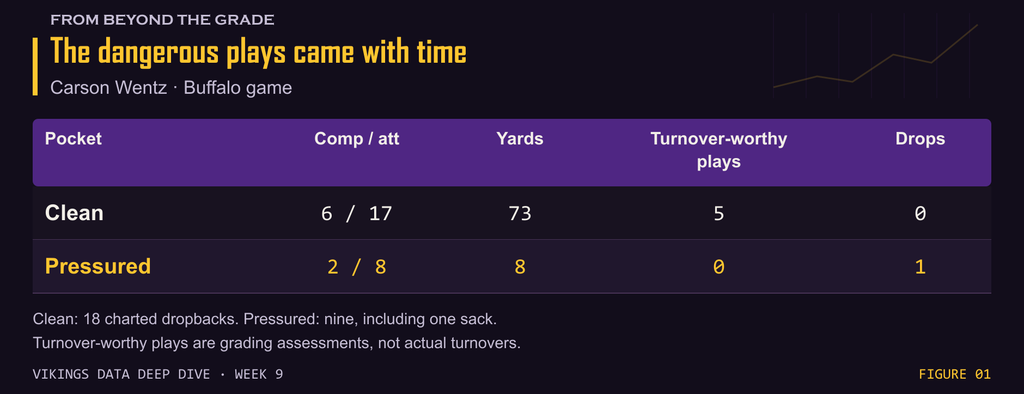
Under pressure he went two-of-eight for eight yards, with a sack. That was awful too. But blaming the pressure for the whole evening lets the clean-pocket performance escape scrutiny, and it absolutely shouldn’t.
Buffalo blitzed on only seven of Wentz’s 27 charted dropbacks (25.9%). Against no blitz, he completed seven of 20 for 69 yards and recorded four turnover-worthy plays. No blitz doesn’t mean no pressure, but the Bills weren’t dependent on repeatedly sending extra rushers to force the offense into trouble.
A turnover-worthy play isn’t an actual turnover, and a clean pocket doesn’t guarantee an open receiver. Neither qualification makes five such plays, two interceptions and zero drops remotely reassuring. I can accept losing a difficult matchup. I find it much harder to accept how little Minnesota achieved when the protection gave it a chance.
Buffalo’s coverage was there to be tested
The Bills entered the game 29th in overall defensive grade and 31st in coverage. Their pass rush ranked seventh, so this wasn’t a uniformly poor defense. But there was a clear weakness for an offense with Jefferson, Addison and Hockenson to attack.
Minnesota finished with 178 total yards, the fewest among the 30 teams playing in Week 9. Its 17:28 possession was also the least, and it was the only team without a third-down conversion: zero from eight attempts.
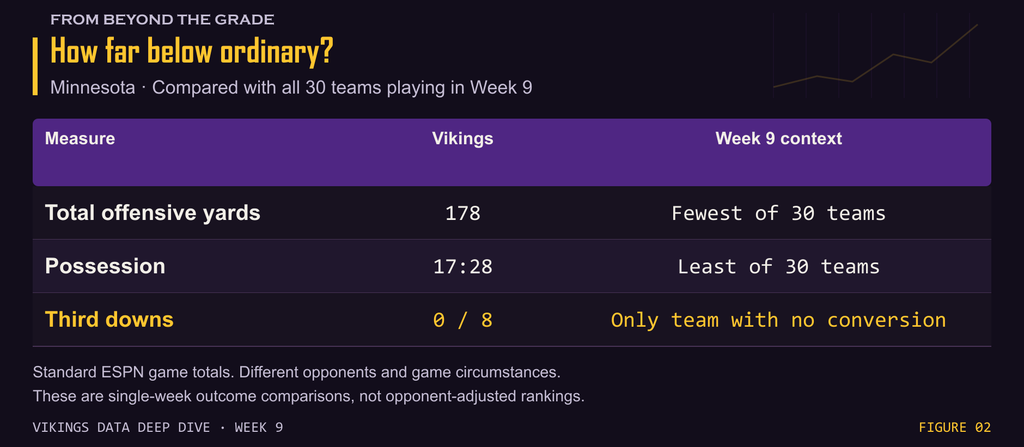
Wentz’s 32.0% completion rate was the lowest of this week’s 30 passers with at least 10 attempts. The next-lowest was 52.0%. That’s a single-week comparison, with different opponents and circumstances, but it gives some scale to how far below ordinary this was.
Jefferson caught 3 of 10 targets for 58 yards, with one drop. That doesn’t establish that he was covered on every other incompletion, just as it doesn’t clear him of every poor rep. What it shows is an offense getting very little return from 10 opportunities directed at its best receiver. Calling Buffalo a good team doesn’t explain that away.
The defense answered the tackling criticism
I complained about the tackling after Detroit. Against Buffalo, the run-defense report records three missed tackles, compared with 14 against the Lions. Cashman, Van Ginkel and Metellus had one apiece; Wilson had none against the run.
James Cook reached 107 yards, but it took 31 carries (3.45 yards per carry). His longest was 11 yards, and he forced two missed tackles. He gained 78 yards after contact, or 2.52 per carry, against the 5.29 Detroit’s Gibbs and Vaki produced against Minnesota.
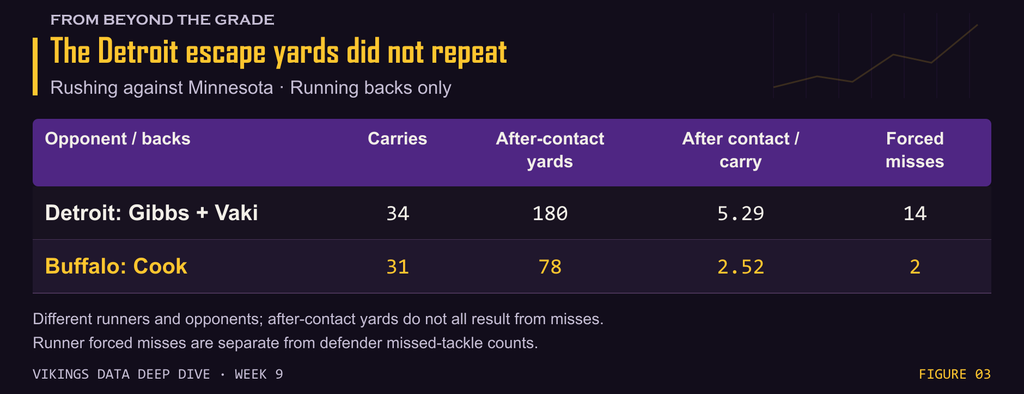
Cook’s own previous seven games provide another check. He’d averaged 5.12 total yards per carry, including 2.25 before contact and 2.87 afterwards. Against Minnesota those components fell to 0.94 before contact and 2.52 after. The defense reduced both his initial room and what followed.
There were still failures, including the late rushing touchdown, but this wasn’t Detroit’s backs repeatedly escaping contact all over again, and I’m not going to pretend it was because I’m angry about the result.
The pressure work also had substance. Allen was pressured on 19 of 38 charted dropbacks (50.0%), compared with 37.8% across his previous games. On Minnesota’s blitzes he went 12-of-21 for 108 yards, took all four sacks and recorded all three turnover-worthy plays. His passing grade on those blitzed dropbacks was 36.2.
Without a blitz he went 9-of-10 for 126 yards. Those 10 dropbacks are too few to prescribe an alternative game plan, and Buffalo still landed damaging plays under pressure. Even so, Flores’ defense disrupted Allen enough to give a functioning offense something to work with. Six points was a miserable return for that effort.
Part 2: What the season is telling me
The offensive problems aren’t shared equally
Minnesota now ranks 30th in offensive grade and 27th in passing, while its pass blocking ranks seventh. Run blocking is 25th, a separate weakness that shouldn’t get lost in the quarterback discussion.
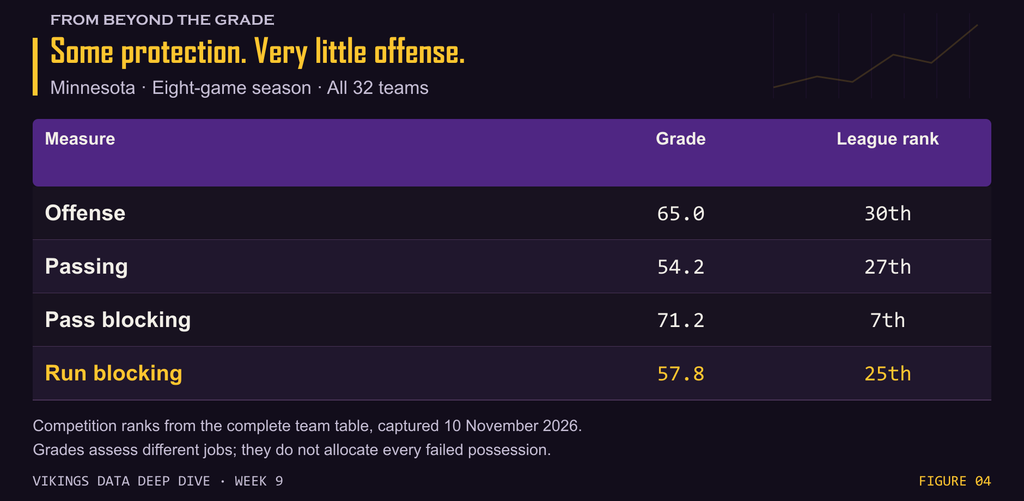
Those grades assess different jobs; they don’t allocate every failed possession neatly between the quarterback, receivers and coaching staff. They do make a blanket “the line is terrible” explanation difficult to sustain. Some of the protection has been considerably better than the offense it supports.
Mason’s involvement deserves a question here. He gained 35 yards on six carries against Buffalo, compared with Jones’ 16 on five, and allowed no pressures on three eligible protection opportunities. I would have liked more opportunity to see whether that running could continue.
But I can’t turn six carries into certainty that 20 would have fixed the game. Both backs average roughly 4.1 yards per carry this season. Mason’s stronger rushing grade, 73.8 against Jones’ 66.3, comes on 44 carries against 115. There’s a case for examining the allocation, without pretending a few extra handoffs would automatically have rescued everything else.
The same restraint applies to Brosmer. Six completions from seven attempts, 58 yards and no turnover-worthy plays were welcome after what preceded them. His relief production supplied 41.7% of Minnesota’s 139 gross passing yards, which also flatters the final passing total compared with what Wentz achieved. Seven attempts in late relief still don’t prove he’s the answer at quarterback.
Rookie watch: progress inside an uneven season
Orange supplied something worth building on. His 69.8 run-defense grade over 16 run snaps followed 40.4 against Detroit. He recorded two solo run tackles, an assist, one run stop and no run miss, then added a pressure on six rushes.
His cumulative run grade is now 44.0, up from the previous snapshot’s 38.8. That still ranks 106th of 141 interior defenders with at least 50 run-defense snaps. A better game has moved the season assessment; it hasn’t made the earlier problems disappear.
Redmond remains first in that same comparison, with a 90.1 run grade on 176 run-defense snaps. Banks’ unchanged 29.6 on 54 run snaps ranks 138th. There’s no Bills game row for Banks in the retained report, so the numbers alone don’t establish why he didn’t feature. The rotation remains uneven, with Orange giving a more encouraging contribution this time.
Golday’s defensive opportunity is growing too. He played 12 defensive snaps against Buffalo, following nine against Indianapolis and four against Detroit. Those 12 account for 37.5% of his entire 32-snap defensive season.
He produced a run stop without a run miss across eight run-defense snaps; his four coverage snaps drew no targets. That’s a useful contribution, though nowhere near enough coverage work for a confident verdict. His special-teams season remains strong at 90.1 across 158 snaps, despite a more ordinary 61.8 against Buffalo.
Next game, I want to see clean-pocket possessions producing something useful, the better run tackling continuing, and Orange and Golday turning this week’s opportunities into more reliable work.
I’ll take those developments seriously because the players earned them. They don’t soften my judgement of the offense. Minnesota got a better tackling response, disruption against Allen and some useful young-player contributions, then managed six points against a defense with established weaknesses. At 6–2, I want to see those advantages turned into possessions and touchdowns. After that performance, I’m thoroughly fed up with waiting.