

San Francisco may well be the best team in the NFL right now. That’s where I’ve landed after the 35–10 defeat in Mexico City. I’d hoped Minnesota could make a much closer game of it after beating Green Bay, but the 49ers showed how good they are and how much the Vikings still have to improve.
Week 11: Vikings 35–10 49ers · 10 regular-season games · 7–3
It was humbling. I’m disappointed with the mistakes and the missed opportunity, but I don’t think this result makes the season a disaster. Minnesota are 7–3, with plenty of football left and enough good performances behind them to believe they can respond. Giving San Francisco their due seems a more useful starting point than treating this as proof that everything has fallen apart.
The numbers help explain the gap. Minnesota blitzed Purdy on 24 of his 27 dropbacks, yet pressured him on only seven. Behind that rush, two short and intermediate areas between the numbers supplied 209 of his 255 passing yards. San Francisco protected him, he found the available throws and the receivers made those completions count.
The tackling and coverage concerns I’ve raised haven’t disappeared. There are also individual performances worth recognising, and some useful distinctions between what Minnesota needs to fix and what an excellent opponent did exceptionally well.
This week’s dive uses PFF’s game charting and cumulative grades through 10 Vikings games, captured on 23 November, alongside ESPN’s conventional box score. Where their counting rules differ, I’ll make that clear.
Part 1: The 49ers game
Nearly 9 blitzes in every 10 dropbacks, and Purdy still had answers
San Francisco handled one of the main things that makes this Minnesota defense difficult to play against. Brock Purdy faced a blitz on 24 of his 27 dropbacks: 88.9%. Only seven of those blitz dropbacks generated charted pressure.
Seventeen times Minnesota blitzed without producing pressure. Purdy completed 19 of 23 passes for 231 yards and two touchdowns against those blitzes, earning a 91.6 passing grade.
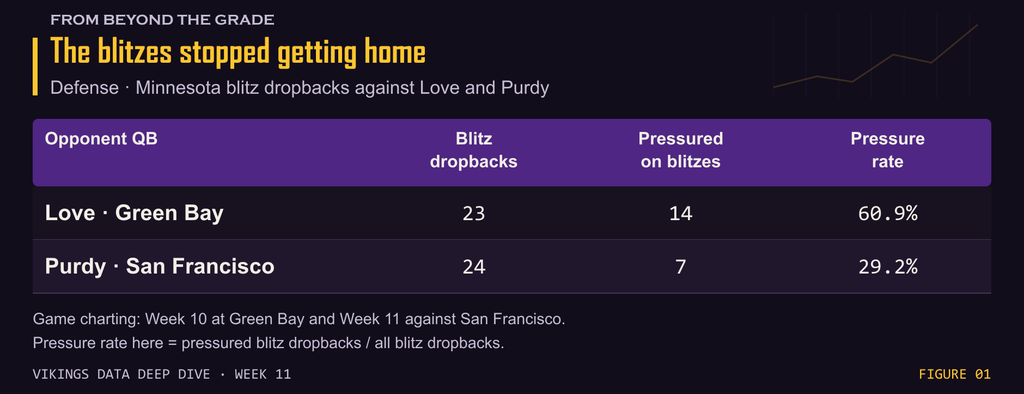
Last week, 23 blitz dropbacks against Jordan Love produced 14 pressured dropbacks. Almost the same number of opportunities, half the disruption. The performance against Green Bay was encouraging, but San Francisco presented a substantially harder test.
The opponent explains some of that difference. San Francisco’s offensive pass-blocking grade ranks first in the league; Green Bay’s ranks last. Their offensive run blocking also ranks first, and their overall offensive grade ranks second. There’s a sustained level of quality here behind my view of the 49ers, beyond what they did to Minnesota in one game.
But Purdy also completed five of six passes for 67 yards when Minnesota did pressure him. He didn’t merely survive those plays. He averaged more than 11 yards per attempt on them, without a turnover-worthy play.
I can’t turn three non-blitz dropbacks into proof that Flores should have stopped blitzing. I can say the defensive approach depended on disruption that wasn’t arriving often enough, and Purdy handled several of the occasions when it did.
The middle was a problem before the ball became a deep completion
Purdy didn’t complete a single pass targeted 20 or more yards downfield. He still threw for 255 yards and three touchdowns.
Between the numbers, his targets travelling 10–19 yards produced six completions from six attempts for 104 yards and a touchdown. The shorter targets of 0–9 yards in that same area produced eight catches from nine attempts for 105 yards and another touchdown.
Those two areas supplied 209 of his 255 passing yards. There were 14 completions from 15 attempts, with receivers gaining additional yardage after the catch. San Francisco didn’t need a succession of long throws to keep taking substantial gains.
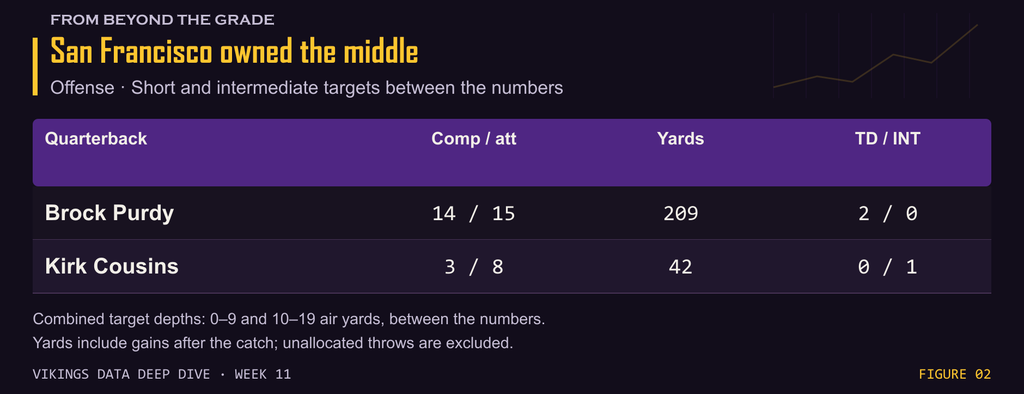
Kirk Cousins’ equivalent targets produced three completions from eight attempts, 42 yards and the interception. Minnesota did complete two deep targets for 51 yards, but the much more repeatable work through the middle belonged overwhelmingly to San Francisco.
Last week’s lookahead focused on Kittle and McCaffrey’s receiving threat. They combined for 47 yards here, although Kittle’s two touchdowns certainly hurt. Evans was the larger yardage problem: 109 yards on 16 routes, with six receiving first downs. The concern about stronger protection was justified; the damage wasn’t distributed exactly as I’d anticipated.
Pierre gave Minnesota something to build on
James Pierre’s game deserves attention within the wider defensive assessment. Across 24 coverage snaps, he was charged with two targets, one catch and zero net receiving yards. His overall defensive grade was 84.5, with 77.8 in coverage.
Elsewhere, Blake Cashman was charged with four catches for 64 yards and Theo Jackson with two for 52; together, that’s six completions for 116 yards. That doesn’t identify every assignment or tell me which defender was responsible for every mistake, but it does show how different individual performances were inside the same team result.
Cashman still has a 75.9 cumulative coverage grade. He had a poor game against an excellent offense, within a much stronger season. Pierre’s contribution is another reason to examine the individual work rather than write off the whole group on the scoreline.
Having the ball wasn’t the same as doing enough with it
Minnesota won time of possession by almost five minutes, 32:23 to 27:37. They converted half their third downs (7 from 14) and finished only 19 total yards behind San Francisco.
Those figures show Minnesota could sustain possessions. They also need to sit alongside the difference in how efficiently the two teams turned opportunities into yards and points.
The Vikings needed 65 official offensive plays to reach 324 yards. San Francisco gained 343 on 53. Minnesota’s slight advantage in net passing yards (255–253), took 43 attempts and a sack; San Francisco needed 27 attempts and a sack. That’s 5.80 versus 9.04 net yards per passing play.
Then came the possessions that actually produced points: Minnesota scored a touchdown on one of three red zone trips; San Francisco managed four from four. The Vikings lost the turnover count 2–0, including Brown’s pick-six. Seven of San Francisco’s 35 points came from their defense, rather than five offensive touchdown drives.
The impression that Cousins was under siege on every dropback needs challenging, too. He was pressured on 11 of 40 charted dropbacks: 27.5%. When clean, he completed 23 of 28 for 195 yards. Under pressure, he was 3 of 10 for 40.
The drop in production under pressure needs work, and the interception came from a clean pocket. O’Connell accepted responsibility for the call; Cousins acknowledged needing to see the backside safety and progress. Those are specific things to address. The offense also moved the ball well enough at times to make this a more useful assessment than simply declaring nothing worked.
For clarity, Minnesota conceded one official sack. Buckner and Odighizuwa share it, half each in ESPN, while the charting gives each a full individual sack credit. Adding those credits together would invent a second sack that didn’t happen.
Hockenson helped, the receiving workload still raises questions
T. J. Hockenson’s return produced six catches for 55 yards on 29 routes. That was useful, dependable work against a defense whose cumulative coverage grade now ranks 11th, and 4th in tackling.
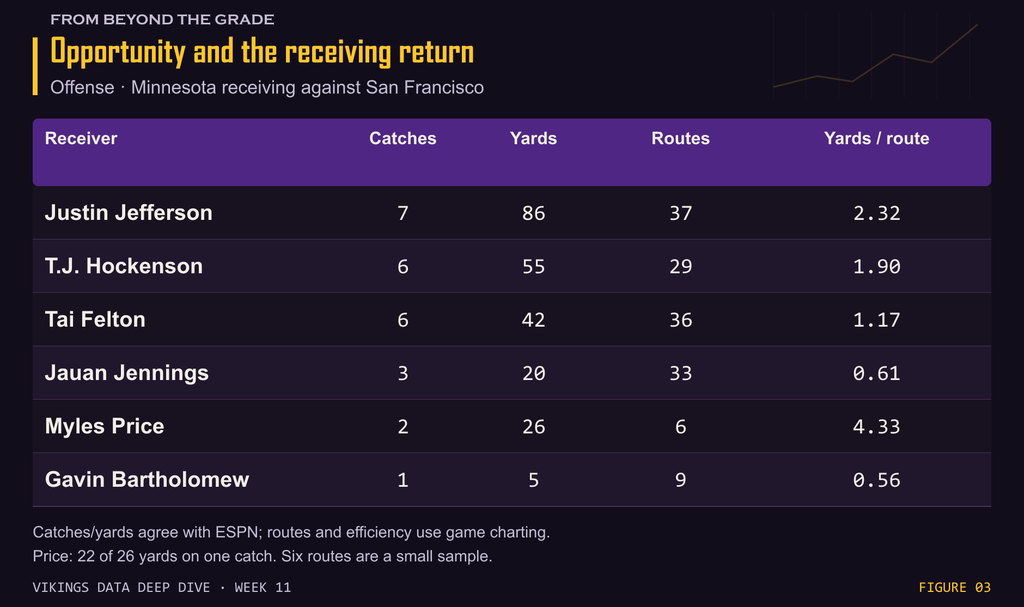
Tai Felton and Jauan Jennings combined for 62 yards across 69 player routes, just 0.90 yards per route. Those are two receivers’ workloads added together, and the return wasn’t enough to relieve the burden elsewhere.
Price gained 26 yards on six routes, after running 22 against Green Bay. One 22-yard reception supplied most of that production, so I’m not claiming six routes prove he should suddenly get a starter’s workload. Price also spent time in the medical tent before returning to the game.
Even with those qualifications, his contribution deserves attention. Hockenson supplied a reliable option, Price made something from very little opportunity, and the receivers with much larger workloads didn’t consistently deliver enough alongside them.
Part 2: Ten games into the season
Keep the season’s strengths and weaknesses in proportion
I still think the tackling and coverage deserve scrutiny. Accepting how good San Francisco are doesn’t mean setting aside the weaknesses that were visible before this game.
Minnesota’s cumulative defensive tackling grade now ranks 27th, while defensive coverage ranks 26th. Last week’s snapshots placed them 24th and 20th respectively. Those concerns were present before San Francisco turned up.
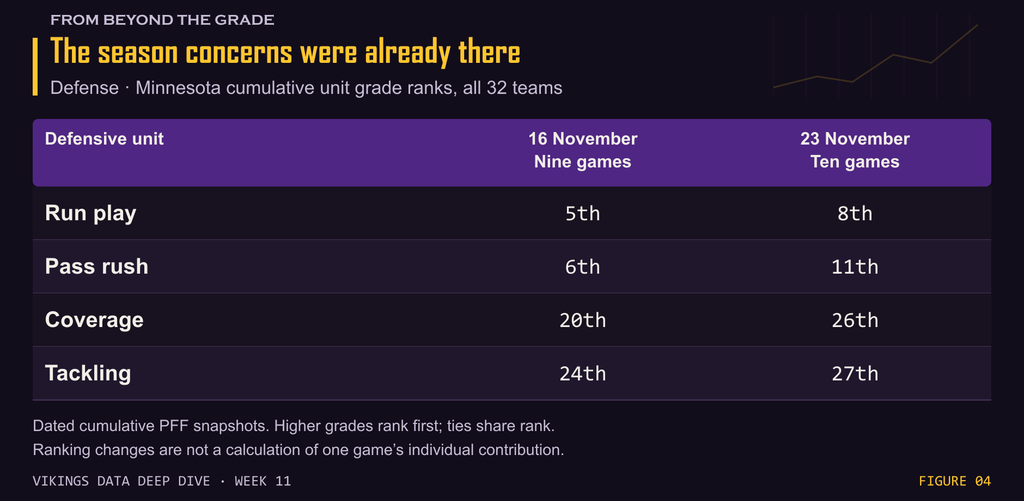
The distinction within that defense is worth keeping. Run play still ranks 8th and pass rush 11th. Against San Francisco, seven overall missed tackles included only two run-defense misses. The 49ers’ running backs combined for 64 yards on 20 carries, with Deebo adding 27 on two.
The run defense held up better than the score might suggest. Minnesota’s greater difficulties were covering, disrupting the passer and finishing enough of the resulting opportunities. Those jobs need improvement, but the stronger work against the run remains part of the season assessment too.
The safety figures are particularly uncomfortable. Among 89 safeties with at least 150 coverage snaps, Metellus ranks last in coverage grade, Smith 85th and Jackson 82nd. Metellus has a different, more varied role than plenty in that group, but I can’t dismiss all three assessments as the product of one bad game.
There are sustained positives elsewhere. Pierre has allowed 14 catches on 26 charted targets for 122 yards and no touchdowns over 184 coverage snaps. Hockenson’s 83.1 receiving grade ranks 3rd among 50 tight ends with at least 100 routes, with no charted drops.
The less encouraging receiving pattern is Felton’s 0.72 yards per route and Jennings’ 0.39: 86th and 89th among 90 wide receivers with at least 150 routes. Different roles and quarterbacks affect those returns, but the difficulty getting efficient production alongside the established targets extends beyond Mexico City.
Rookie watch: Golday’s small role is encouraging, Banks’ progress is unfinished
Jake Golday supplied two run stops in seven run-defense snaps against San Francisco. His defensive season now covers 60 snaps, four overall stops and no missed tackles, with a 77.1 defensive grade. I like what he’s producing in the opportunities available; three coverage snaps in this game don’t establish that he’s ready to solve the problems behind the rush.
Banks followed his encouraging Packers performance with 16 defensive snaps, eight pass rushes, and no pressures or credited tackles. His 63.1 defensive grade for the game was better than that empty box score contribution might suggest, but his season remains at 140 defensive snaps, four pressures on 71 rushes and a 40.6 overall defensive grade. There’s still considerable work ahead.
Orange played 23 defensive snaps, recording a run stop and a run miss, without any pressures on 11 rushes. His cumulative 169 defensive snaps have produced three pressures on 65 rushes and a 48.0 defensive grade. Neither young tackle has yet supplied consistent pass rush production.
Jakobe Thomas added nine defensive snaps, with a tackle and an overall defensive stop. He’s separate from undrafted Jacob Thomas, who played 12 defensive snaps and now has 86 for the season. Their similar names are doing nobody any favours.
Bartholomew’s touchdown last week also needs a more measured follow-up: one catch for five yards on three targets here, with a drop. His season stands at 11 catches for 95 yards on 65 routes, two drops and a 61.9 receiving grade. There have been useful contributions, but the consistency hasn’t arrived yet.
Atlanta: a chance to respond, with specific tests ahead
Atlanta offer an opportunity to respond at home, with a very different set of strengths and weaknesses. They’re 3–7. Their offensive passing grade ranks 31st, but offensive rushing ranks 3rd. Their defensive pass rush ranks 2nd, while defensive run play ranks 27th.
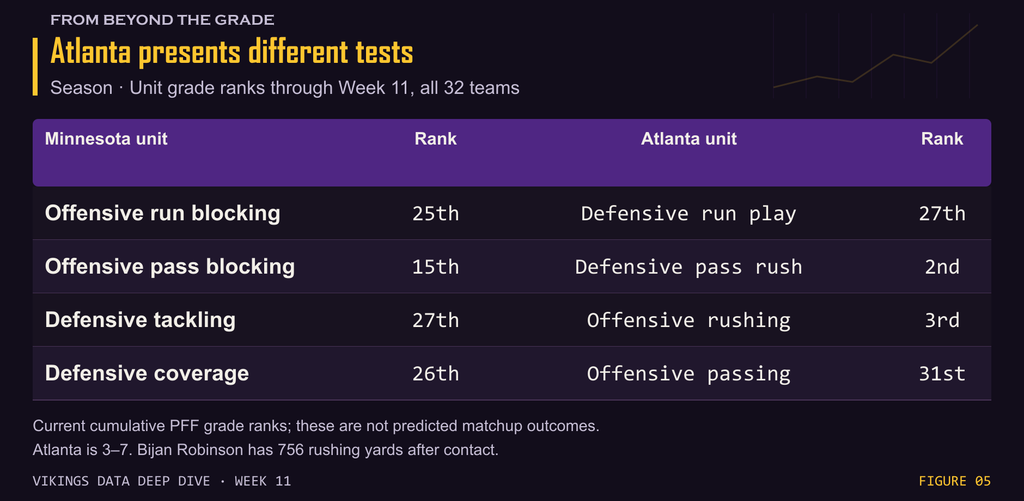
Bijan Robinson has 951 rushing yards on 185 carries, with 756 after contact. That’s 79.5% of his rushing yardage, alongside 37 forced missed tackles. Minnesota’s ability to get to him will only be half the job. Finishing those tackles is exactly the concern I keep coming back to.
Drake London gives Atlanta a substantial receiving threat despite that team passing grade. His 801 receiving yards on 296 routes produce 2.71 yards per route, 6th among those 90 qualifying wide receivers. He has 351 yards after the catch. Minnesota will still need better coverage and tackling against him.
If Penix starts, creating actual pressure offers an opportunity: his season passing under pressure is 20 completions from 65 attempts, 312 yards, one touchdown and four interceptions. When clean, he’s 127 of 177 for 1,418 yards, nine touchdowns and three interceptions. Getting to him would give Minnesota a much more favourable passing matchup than they experienced against Purdy.
On offense, Atlanta’s weak defensive run play assessment offers an opening, although Minnesota’s offensive run blocking ranks 25th. Making more of that matchup could help the Vikings sustain drives without repeatedly asking Cousins to convert difficult passing downs against a strong rush.
I’d like to see that response in tackles finished against Bijan, pressure that reaches the quarterback and possessions that produce more points. San Francisco have shown Minnesota the level they need to reach. At 7–3, the Vikings still have plenty of season left to work towards it, and I’m interested to see how they respond to being humbled by a team who might currently be the best of the lot.