

A Lambeau win, some overdue contributions from the supporting cast, and a few numbers that make the trip to Mexico City rather less comfortable. Darren Hails looks into the numbers beyond the scoreline that took the Vikings to 7–2.
Week 10: Vikings 30–10 Packers · Nine regular-season games · 7–2
Grades, pressures, routes and passing splits are from PFF Premium Stats; conventional game totals use the ESPN box score. Shared sacks can be split in the box score but credited in full to both defenders in the charting. Team sack totals below count actual sacks; differing individual credits are identified. Season comparisons use data captured on 16 November. League rankings and workload cut-offs are stated where used. Week 6 was Minnesota’s bye.
That felt a bloody sight better. After the anger of the Buffalo game, I needed an evening when the offense gave me something to enjoy. Doing it at Lambeau made it considerably sweeter.
KIrk Cousins coming back and helping Minnesota beat Green Bay 30–10 is an easy story to like. I’m quite happy to like it. There were touchdowns, third-down conversions and contributions from players who haven’t had much of the attention in this series. Finally, something other than another argument about how an offense with this much talent could achieve so little.
But some of the explanations I might have reached for don’t survive the numbers. Play action was poor. Most of Love’s sacks came without a blitz. And conceding only 56 rushing yards didn’t mean the tackling had been sorted out.
Those details make this a more interesting win to pick apart, particularly with the 49ers next.
Part 1: Inside the Green Bay game
The passing worked. Play action mostly didn’t
Cousins completed 15 of 18 passes for 173 yards without play action, throwing both touchdowns in that split. With play action, he went 6-of-13 for 34 yards.
That’s 9.6 yards per attempt against 2.6. The passing grades were 82.9 without the fake and 35.2 with it. Play action accounted for 14 of his 36 dropbacks, so this wasn’t a couple of unsuccessful calls disappearing into an otherwise productive evening.
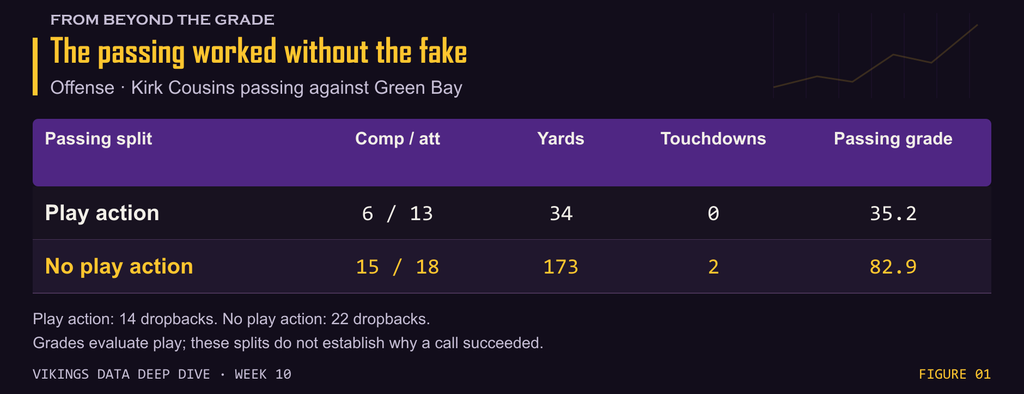
I’d have found it easy to explain the improvement as Cousins stepping back into familiar play-action football. Instead, the successful passing came predominantly without it. Those attempts supplied nine passing first downs; play action supplied two.
The more encouraging change was what happened when the protection gave the quarterback a chance. From a clean pocket, Cousins completed 19 of 26 for 200 yards, with one turnover-worthy play. Against Buffalo, Wentz managed 6 of 17 for 73 yards, with five such plays. Neither passer had a drop in those clean-pocket splits.
Different opponents prevent that being a neat experiment in swapping quarterbacks. Even so, I spent last week’s article furious about wasted opportunities without pressure. This time, those opportunities produced something useful.
Cousins still took three sacks on nine pressured dropbacks, and his pressured passing yielded only seven yards and an interception. I enjoyed the improvement enormously. I’m not pretending every part of his game was good.
Price and Bartholomew did more than appear on the scoresheet
Myles Price caught all four targets for 49 yards on 22 routes. Gavin Bartholomew caught three of four for 36 yards on 24 routes. Between them, they supplied 41% of Minnesota’s passing yards and both passing touchdowns.
Price gained more receiving yards in this game than in his previous appearances combined: 49 here, against 32 beforehand. His return rose from 0.51 yards per route before Sunday to 2.23 in this game. That doesn’t establish him as a consistently productive receiver yet, but it gives him a contribution worth discussing beyond his return work.
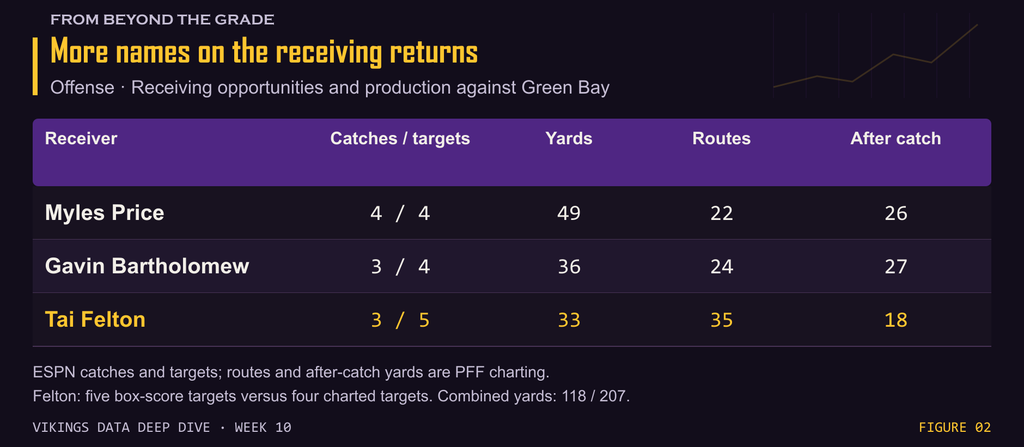
Bartholomew’s evening needs a little more scrutiny. Of his 36 yards, 27 came after the catch, but he also had a drop and a 62.6 receiving grade. His touchdown didn’t make it a flawless catching performance. Yurosek, meanwhile, caught his sole target for seven yards across 12 routes; the backup tight ends didn’t have interchangeable games.
Tai Felton deserves a mention too. He ran 35 routes, matching Jefferson’s workload, and caught three passes for 33 yards. The sources differ on his opportunities: ESPN lists five targets, while PFF assigns four. That’s still less than a yard per route, so the opportunity was greater than the production. Add his contribution to Price and Bartholomew, though, and those three supplied 118 of Cousins’ 207 yards.
There’s a revealing detail on the other side. Green Bay ranks second in defensive pass-coverage grades for the season, yet the two touchdown gains – 38 and 20 yards – were charged to Brandon Cisse and Nick Niemann respectively. They had nine and one coverage snaps. Nixon and Valentine were charged with 53 yards between them and no touchdown.
That explains how the excellent unit assessment and those damaging scoring plays can coexist. It doesn’t prove Minnesota deliberately hunted those defenders. It does show why “the Packers have great coverage” is too broad an explanation of every matchup on the field.
Love’s 118.8 rating leaves out five sacks
On dropbacks without a blitz, Love completed six of seven passes for 89 yards, a touchdown and an interception. His passer rating was 118.8.
He also took five sacks on those 12 dropbacks. Both his turnover-worthy plays came without a blitz, and his passing grade in that split was 37.3.
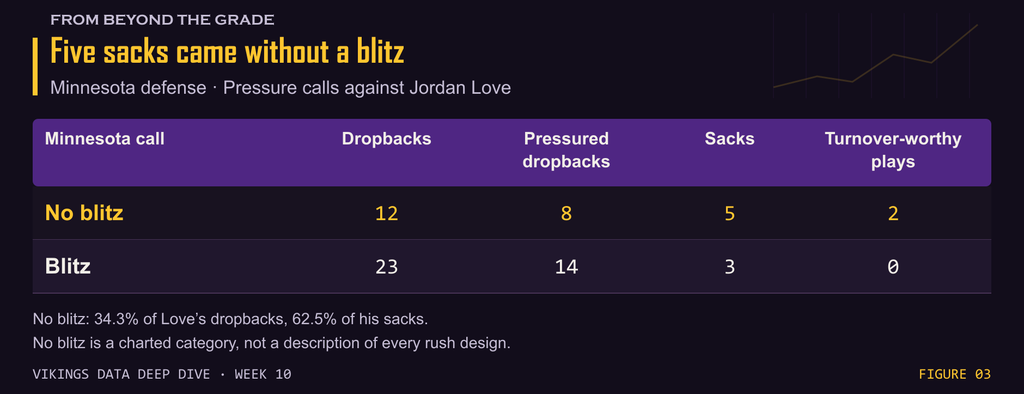
Passer rating leaves sacks out, which makes that 118.8 a fairly generous description of the experience. Five of Minnesota’s eight sacks came on the third of Love’s dropbacks without a blitz.
Flores still blitzed frequently. This isn’t an argument that he should have stopped. It shows that the damage wasn’t dependent on sending extra rushers, although “no blitz” doesn’t establish the exact rush design on each play.
Love was pressured on 62.9% of his dropbacks, compared with 37.2% across his previous games. Once pressured, he was sacked 36.4% of the time, against 12.5% beforehand. Minnesota increased both how often the protection came under strain and how frequently that strain ended the play.
Rodriguez earned the attention, Williams deserves some too
PFF credits Levi Drake Rodriguez with eight pressures on 24 rushes: two sacks, two hits and four hurries. His two sacks also match the ESPN box score; the hits and hurries here are separate charting categories. His 92.4 defensive pass-rush grade reflects repeated disruption, with a pressure on a third of his rushes.
Those eight pressures equal half his currently reported season total, produced on only 15% of his season rushes. That’s a huge evening within a season that hasn’t consistently looked like this.
Green Bay’s protection provides necessary context. The Packers entered the game last in offensive pass-blocking grade – the assessment of how well they protect their quarterback – and remain there. Minnesota exploited an established weakness; a stronger line will test whether this level of disruption carries over. I’m still delighted the front made the weakness hurt.
Elijah Williams supplied another contribution I don’t want to lose underneath the sack total. His box-score return was five tackles, four solo, and a sack. The charting adds three run stops – tackles classed as an offensive failure – across nine run-defense snaps, alongside that sack on 12 rushes. That’s useful work across both parts of a 21-snap defensive appearance, and exactly the sort of player who should get more space here.
Part 2: What the season is telling me
The tackling concern hasn’t gone away
I credited the response against Buffalo after criticising the Detroit tackling. Green Bay brought another step backwards: six missed tackles against the run, following three against the Bills. There were nine misses across all defensive plays.
The Packers’ backs gained 56 yards on 16 carries, but 45 came after contact. They had only 0.69 yards per carry before it. Minnesota restricted the initial room without consistently finishing the tackle afterwards.
Kaleb Johnson’s 10 carries are particularly useful here. He gained 42 yards, including 37 after contact. Taking this game out of his current season totals leaves 42 carries for 172 yards, with 151 after contact. His yards per carry were 4.2 against Minnesota and 4.1 across the rest; his room before contact was 0.5 yards per carry in both.
So I can’t describe his individual evening as a shutdown simply because the team rushing total was small.
Minnesota’s defensive season grades now rank fifth against the run and sixth in pass rush, but 24th in tackling and 20th in pass coverage. That unevenness is a better description of the defense than treating the whole unit as equally strong.
Metellus’ 31.4 defensive pass-coverage grade ranks last among 85 safeties with at least 150 coverage snaps. His hybrid assignments make that an imperfect comparison of roles, but 456 yards charged across 36 targets also warrant concern. Smith’s interception was welcome; his defensive pass-coverage grade for the season still ranks 80th in that same group.
I’m pleased with what the defense did to Green Bay. I’m also still worried about what happens when the rush doesn’t end the play early.
Offensive protection: Brandel is giving Cousins something dependable
Blake Brandel allowed no pressures across 36 eligible protection opportunities, earning an 84.1 offensive pass-blocking grade. Joe Huber also allowed none across 36.
Brandel’s season assessment is the stronger finding: seventh in offensive pass blocking among 34 centers with at least 100 eligible protection opportunities. His current total is nine pressures allowed on 303 opportunities, roughly 3%.
The line wasn’t uniformly good against Green Bay. The offensive pass-blocking charting assigns two sack-allowed charges to Darrisaw, one to Fries and one to O’Neill. Those are four individual charges against three actual sacks of Cousins, not four separate sacks conceded. They describe the charted responsibility, rather than a new team total. Cousins’ improved production shouldn’t hide those failures, just as those failures shouldn’t erase Brandel’s work.
After the amount of attention the quarterbacks have needed, I appreciate being able to point to a less dramatic part of the offense doing its job. Brandel has a substantial workload behind that assessment, rather than one good Sunday.
Rookie watch: better contributions, with plenty still to prove
Banks returned to record two run stops on seven run-defense snaps. Orange added two on four. Both had encouraging game grades, but their cumulative assessments still reflect much harder games earlier in the season.
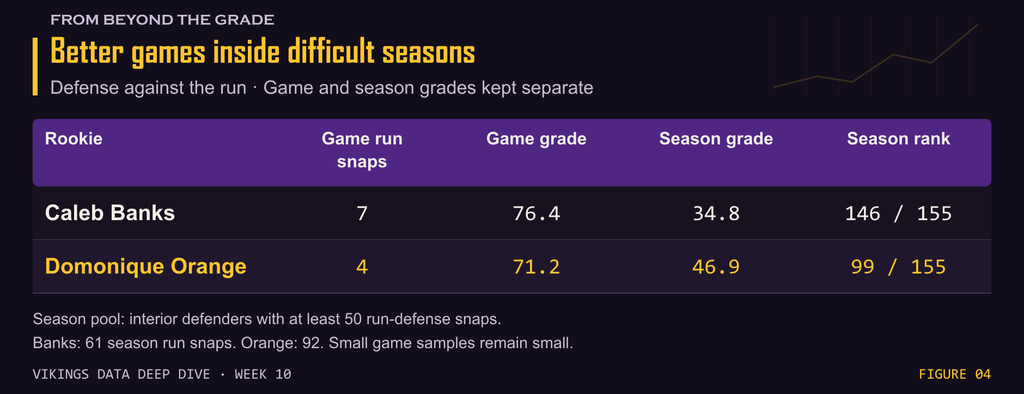
Banks has one hurry from this game’s 10 rushes; Orange had no pressures on three. I can recognise their better run contributions without declaring the whole interior rotation sorted. Orange also played only seven defensive snaps after 22 against Buffalo. A better grade on fewer opportunities doesn’t establish a growing role.
Golday’s opportunity is growing. His 18 defensive snaps brought him to 50 for the season, with 60% coming in the last two games. One incomplete target across eight coverage snaps is a useful outcome, though hardly enough to settle a coverage evaluation.
His special-teams season has more substance: a 90.6 grade across 178 snaps, followed by another visible contribution when he recovered the late kickoff fumble forced by Jakobe Thomas. I’m enjoying that progress. I also want his increasing defensive work to give a clearer answer about how much responsibility he can take on there.
Looking ahead: the 49ers change the test
San Francisco in Mexico City is a fairly abrupt way to find out how much of this carries forward. The 49ers rank first in both offensive pass-blocking and offensive run-blocking grade, compared with Green Bay’s current last place in both. Their offense ranks second overall.
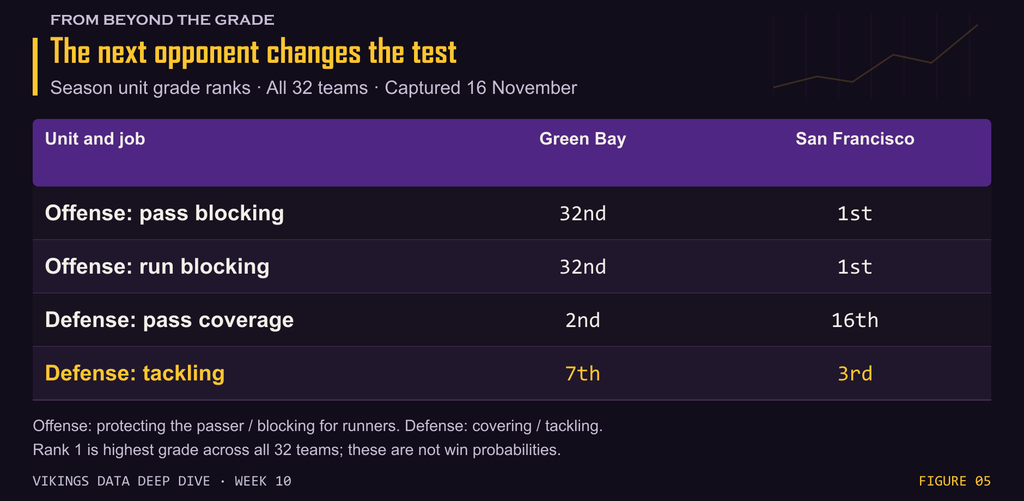
Purdy has been pressured on 30.4% of his season dropbacks. Minnesota reached Love on 62.9% in this game. I’d love another evening of quarterbacks disappearing beneath purple shirts, but stronger protection makes that a much harder expectation. Rodriguez and the pressure without a blitz will have to work against a very different blocking opponent.
The tackling gives me more immediate concern. Kittle and McCaffrey have combined for 988 receiving yards, including 610 after the catch. With Minnesota’s coverage and tackling assessments where they are, that’s an uncomfortable pairing. If the rush arrives later, those underneath completions have more opportunity to become the next problem.
There is an opening for the offense. San Francisco’s defense ranks 16th in pass coverage and 21st in pass rush, so Cousins’ clean-pocket improvement meets a less imposing season coverage assessment than Green Bay’s. But the 49ers’ defense ranks third in tackling. Price and Bartholomew gained 53 of their combined 85 yards after the catch on Sunday; I wouldn’t assume the same return next time.
I’ll be looking for useful passing possessions even when the receiver is tackled promptly, pressure that survives stronger protection, and a better job of finishing tackles against those receiving threats. Those are specific tests this win has left behind.
For now, I’m going to enjoy beating Green Bay. After Buffalo, being able to look ahead with some hope again feels pretty good. San Francisco will find out how much of it is justified.